


What Ethical Leadership Grows
Finding the signal in a noisy world, five macro truths for Australian CEOs in 2026
7 min read
Finding the signal in a noisy world, five macro truths for Australian CEOs in 2026
At The CEO Institute’s CEO Summit in Sydney, HSBC Chief Economist Paul Bloxham described his role in a way that resonated immediately. He sees “a primary part of this job” as “trying to make sense of all of it and sort of strip out the noise and explain to you where the signal is”. He wasn’t talking about chasing every headline. He was talking about prioritising what matters for the global economy and the local economy.
That framing lands because it mirrors the day-to-day reality of leadership. Headlines move fast. Opinions multiply. Everything feels urgent. Yet performance still comes down to a small number of decisions, made consistently and well, over time.
Paul’s outlook for 2026 is easy to summarise. “We are constructive. We think global growth will continue.” At the same time, “we are cautious because the base of that growth is quite narrow and the risks are probably tilted more to the downside.” In his words, it is “constructive and cautious”, and “cautious and constructive” at the same time.
So, what is the signal, and how should CEOs use it?
The themes below distil Paul’s keynote and Q&A into five practical truths for Australian leaders, and the choices those truths put on the table right now.
Truth 1: The world is growing, but the base is narrow, so resilience beats prediction
Paul’s opening position was direct. “Global growth will continue”, but “the base of that growth is quite narrow”. That narrowness is the point. When growth is carried by a handful of pillars, the mood can change quickly, not because the whole system breaks, but because one pillar weakens and markets reprice the story.
This is where CEOs can get caught. A narrow-growth environment tempts leaders into extremes. Either everything is fine, so the business leans into optimism and overextends. Or the world feels fragile, so the business becomes hesitant and defensive.
Paul’s constructive and cautious framing gives leaders a more disciplined posture. It says: keep moving, keep investing, keep building, but design for volatility and keep options open.
For CEOs, the practical move is to stop treating forecasts as a plan. Plans need range. They need decision triggers. They need clarity on what changes when the world changes.
If the base is narrow, the leadership advantage belongs to the organisations that can adjust quickly without losing focus. That is resilience, and it beats prediction every time.
Truth 2: Trade disruption didn’t break growth, because the system rerouted faster than expected
Paul made an observation that matters for every CEO building strategy in uncertain times. Trade policy has not “settled down”. It is still being used as a “device for achieving other objectives”. He described a pattern that many leaders recognise in their own markets, it is “being used as a threat and a bargaining chip but not necessarily delivered”.
That distinction matters. It changes how leaders read headlines. It doesn’t mean trade risk disappears. It means the way it shows up is different, and businesses and markets adapt.
Paul then explained why last year’s disruption did not tip the world into the downturn many expected. He said the early announcements were “much, much more extreme than ended up arriving”. Noticeable tariffs arrived, but “tariffs didn’t arrive in the same sort of way that was announced in the early stage”.
Then came the second factor, adaptation. Countries adjusted quickly, and Paul singled out China. “China managed to very, very quickly redirect” exports that would have gone into the US “into other markets in the world”.
There are two CEO lessons here.
For Australian leaders, the takeaway is not panic. It is preparedness. Trade is still a risk factor, but it is a risk factor that can be managed through scenario planning, commercial agility, and sharper market intelligence.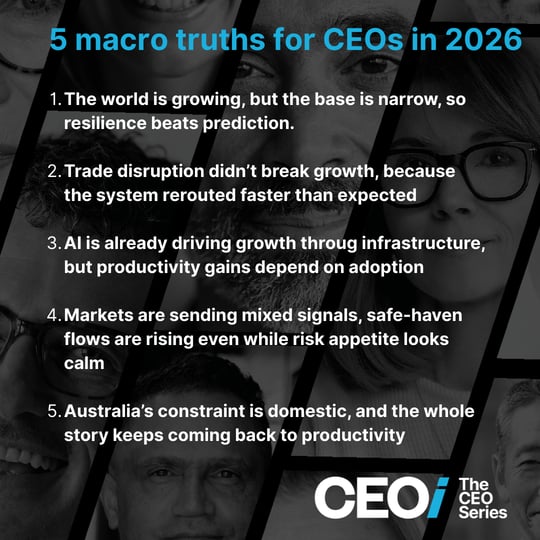
Truth 3: AI is already driving growth through infrastructure, but productivity gains depend on adoption
Paul’s AI commentary cut through a lot of noise because he grounded it in what can be seen and measured.
He described AI’s near-term macro impact as “mostly a construction story at this point”. In the US, he said there has been a massive rollout of data centre construction. He then cited estimates that about 40% of US GDP growth up to that point was being driven by, or had been driven by data centre rollout.
This is not abstract. It’s steel, concrete, power generation, and supply chains. Paul explained the second-order effect CEOs should notice, the components used to build data centres often come from elsewhere. The semiconductors and the hard drives all supported exports out of East Asia, places like Taiwan, Singapore, Korea. In other words, AI is already showing up as an investment cycle with real spillovers into trade and industrial capacity.
But Paul’s sharper point for Australian CEOs was not about the infrastructure boom. It was about adoption.
He explained how all the data tell us that actually AI adoption has been quite slow in the business sector generally. Then, speaking about Australia, he referenced a government survey. “3% of businesses that were surveyed were saying that they are using AI very actively.”
“22% of them said that they’ve got limited use.”
The rest are “not really doing that much”.
That’s the opportunity. If adoption is still low, advantage is still available.
The CEO work is to move from fascination to execution. AI becomes valuable when it changes workflows and operating models. It becomes valuable when it reduces cycle time, improves decision quality, lowers cost-to-serve, and lifts output per hour.
Paul also injected a dose of realism that leaders should take seriously. “It takes time… for businesses to work out how they can best apply these things.” All meaning that the productivity gains might take a while. They might not come immediately.
So, the question for CEOs is not are we using AI? It is we redesigning work? AI is not a tool rollout. It is a productivity programme.
Practical CEO questions worth taking into the next executive meeting:
Truth 4: Markets are sending mixed signals, safe-haven flows are rising even while risk appetite looks calm
Paul described a market pattern that boards should watch closely, because it reveals what investors are nervous about, even when headline indices are high.
“The US dollar’s been weakening… quite a bit,” he said. He linked that weakness to a shift in investor behaviour, global investors, particularly central banks around the world, who have been trying to reduce their holdings of US assets.
Then he explained where that money goes. “There aren’t a lot of other places to be in terms of safe havens, so it’s been driving up gold prices, and silver prices, and platinum prices.” He called the move “an enormous rise” and said, “primarily what it reflects is a safe haven flow”.
He also made the point that creates the real tension for CEOs. The safe-haven behaviour sits beside market pricing that looks calm. He described it plainly, “equity prices are high, credit spreads are low, the market seems to be quite sanguine about the overall risk story”.
That combination matters because it signals uncertainty under the surface. CEOs don’t need to become traders, but leaders do need to understand the practical downstream impacts. When uncertainty rises, funding costs can change. Investor patience can change. Capital becomes more selective. Risk committees become more conservative. M&A conditions tighten. Refinancing assumptions shift.
The CEO response is to protect optionality without losing ambition.
In a world where risk signals can conflict, financial optionality becomes a strategic asset.
Truth 5: Australia’s constraint is domestic, and the whole story keeps coming back to productivity
This was the sharpest part of Paul’s message for Australian CEOs because it connected macro reality to boardroom reality.
He acknowledged that the RBA will dominate headlines, then dismissed that as the real focus. “That is not where the focus ought to be. The focus needs to be on all the things we need to do to get productivity to pick up.” His warning was blunt, “if we don’t get productivity to pick up, we’re just basically stuck in this low-growth economy, with a very low speed limit”.
Then Paul translated productivity and inflation into the language CEOs live in every day, cost base.
“Wages growth… is running at about 3.5% basically on the main metric, 3.5–4% on the main metric that we look at.” He said that’s “an alright rate of wages growth when productivity… runs at about 1% each year”. Why? “You’re paying people 3.5% more, each year they’re producing 1% more. And so… your cost base is growing at 2.5%.”
Then came the leadership problem. In an environment where wages grow at 3.5% but productivity’s zero, that means the cost base is growing at 3.5%. He added that it’s probably growing closer to 4%.
That is the CEO agenda. When productivity is weak, inflation becomes stickier, rate cuts become harder, and businesses feel margin pressure sooner. CEOs then face difficult choices, push pricing, absorb margin compression, or redesign the operating model.
Paul also made a point that prevents lazy thinking. He pointed to mining adopting remote operations as an example. Then he challenged the national narrative with an export comparison that should make leaders sit up. Software license exports last year were worth $7.5 billion. They’ve gone up 20-fold in 10 years. Then, “last year we exported $181 million worth of rare earths and $7.5 billion worth of software licenses. Where’s the story about the software licenses?”
The signal is clear. Australia has pockets of high-value capability. The opportunity is to scale productivity through investment, innovation, and operating model discipline, and to remove policy and cost barriers that stop businesses backing their own growth.
What CEOs should do this quarter, translating the signal into action
If Paul’s signal is right, leaders have five levers to pull now.
1) Strategy
2) Pricing
3) Capex
4) Workforce
5) Productivity bets
Conclusion
If Australia’s speed limit is productivity, CEOs are not waiting for the answer. They are part of the answer.
And in a world that keeps getting louder, the advantage goes to leaders who can see clearly, decide quickly, and execute consistently.
Finding the signal in a noisy world, five macro truths for Australian CEOs in 2026
Cash flow is no longer a finance issue — it's a CEO-level strategic priority.
.png)
Cash flow is no longer a finance issue — it's a CEO-level strategic priority.