The Pulse Report
Geopolitical Special
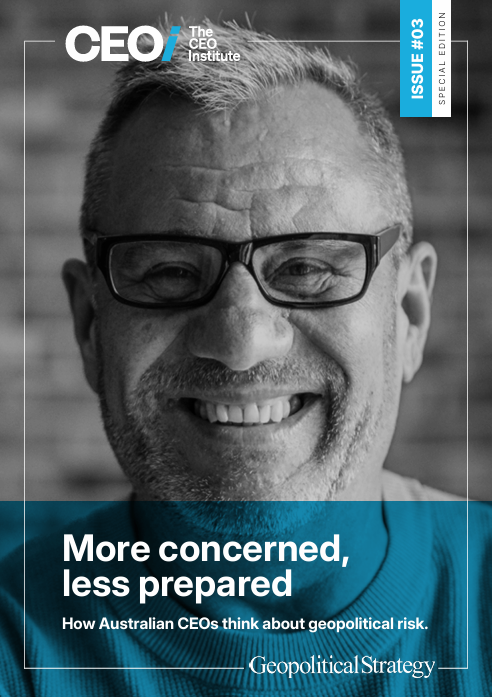
More concerned. Less Prepared.
How Australian CEOs Think About Geopolitical Risk
A special edition of The Pulse Report, developed by The CEO Institute in collaboration with Geopolitical Strategy. Explore how Australian CEOs are pricing geopolitical risk, trade volatility, supply chain disruption and strategic opportunity.
The Pulse Report, Geopolitical Special
How Australian CEOs think about geopolitical risk, and what it means for business strategy, supply chains and long-term decision-making.
This special edition of The Pulse Report captures how Australian CEOs are interpreting a more volatile geopolitical environment, and where they see the greatest risks, opportunities and strategic blind spots.
Developed by The CEO Institute in collaboration with Geopolitical Strategy, the report draws on survey data from Australian CEOs, a series of in-person scenario planning workshops, and a live poll of CEOs conducted during an April 2026 briefing on the Iran crisis and its business impacts.
What CEOs need to know at a glance
Concern has surged
100% of CEOs surveyed in April are more concerned about geopolitics and trade disruption than six months ago. 78% are much more concerned.
Energy volatility has moved to the top
Global oil and energy price volatility is now the leading immediate geopolitical risk, cited by 68% of CEOs in April.
The Iran war is reaching the P&L
CEOs say the conflict is affecting decision-making through fuel, freight, input costs, pricing, contracts, supply chains and customer confidence.
Decision-making is already being affected
41% of CEOs say they have paused or delayed decisions to some extent, while a further 49% are monitoring closely.
Preparedness is not keeping pace
Only 7% of firms have made structural changes in response to geopolitical risk.
Geopolitical risk remains under-embedded
Only 12% of firms treat geopolitical risk as a core strategic input in planning and board decision-making.
Opportunity remains, but the lanes are narrowing
CEOs still see upside in critical minerals, AI and emerging technology, ASEAN growth and deeper commercial ties with India.

What's inside this report
Inside this special edition of The Pulse Report, you’ll find:
- How the Iran war has accelerated CEO concern about geopolitical risk and trade disruption
- The top risks now facing Australian businesses, including energy volatility, Middle East instability, US trade policy and cyber risk
- How geopolitical shocks are flowing through to costs, contracts, supply chains, confidence and decision-making
- How leaders view the United States, China, India, Southeast Asia and the Pacific in a more fragmented world
- Where CEOs see strategic opportunities, including critical minerals, AI, ASEAN growth and deeper ties with India
- Why concern is rising faster than structural action inside many organisations
- Four future scenarios for world order, and what they could mean for business strategy
- A practical framework for moving from recognition to readiness
Want to stay up to date with Geopolitical Issues?
Stay close to the geopolitical developments shaping business, trade, risk and strategy.
Subscribe to Geopolitical Dispatch to receive concise, relevant updates and analysis designed for business leaders who want clarity, not noise.
This report makes clear that geopolitics is no longer a background risk - it is a core operating condition. We're moving into a world defined by constant friction and the businesses that will succeed will be the ones that design for it - not react to it. It is both a constraint and a catalyst for growth
Australian business had been tribal encamped- protected by the waters around us and the distance from Beijing, Washington, London and Moscow. Covid occurred and changed the way business is enacted and with that, a realisation that we are not immune to the events around the globe. Now the geopolitical impacts are impacting our supply lines, our input costs and customer confidence, not to mention our financial markets. We are no longer immune to world events, and this report highlight the pressures we face and the uncertainty ahead.
The hard truth in this report is that the environment has fundamentally changed and shifted faster than most organisations have - and leadership has to change with it. Awareness isn't the issue - decision-making and execution haven't kept pace. Embedding geopolitical thinking into strategy is no longer optional, it's a prerequisite for staying competitive.
Download the Pulse Report - Geopolitical Risk
More concerned. Less Prepared.
How Australian CEOs Think About Geopolitical Risk
A special edition of The Pulse Report, developed by The CEO Institute in collaboration with Geopolitical Strategy. Explore how Australian CEOs are pricing geopolitical risk, trade volatility, supply chain disruption and strategic opportunity.