


The Pulse Report
The Work That Matters
Closing the gap between organisational effort and productive value across Australia and New Zealand.
Most organisations do not have an effort problem. They have a conversion problem.
People are busy, but too much effort is absorbed by friction, competing priorities, unclear authority and work that still depends on a small number of individuals. The fifth edition of The Pulse Report examines where productive capacity is being lost, what is holding execution back and what CEOs, business owners and boards can do next.
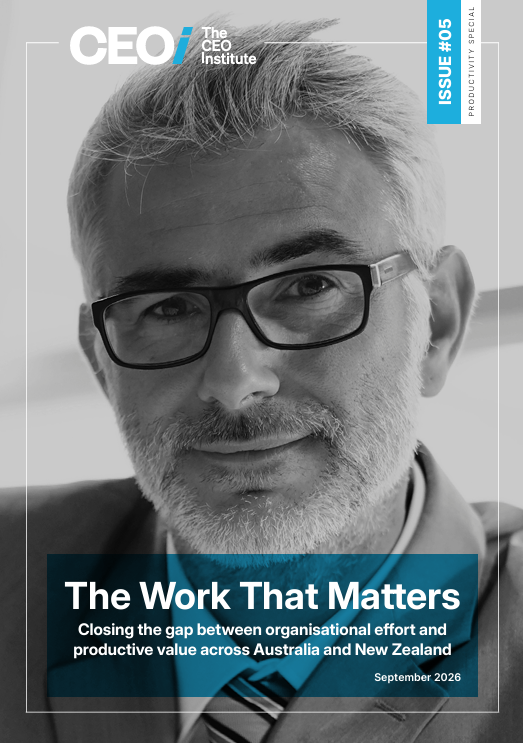
The Pulse Report, Productivity Special, Fifth Edition
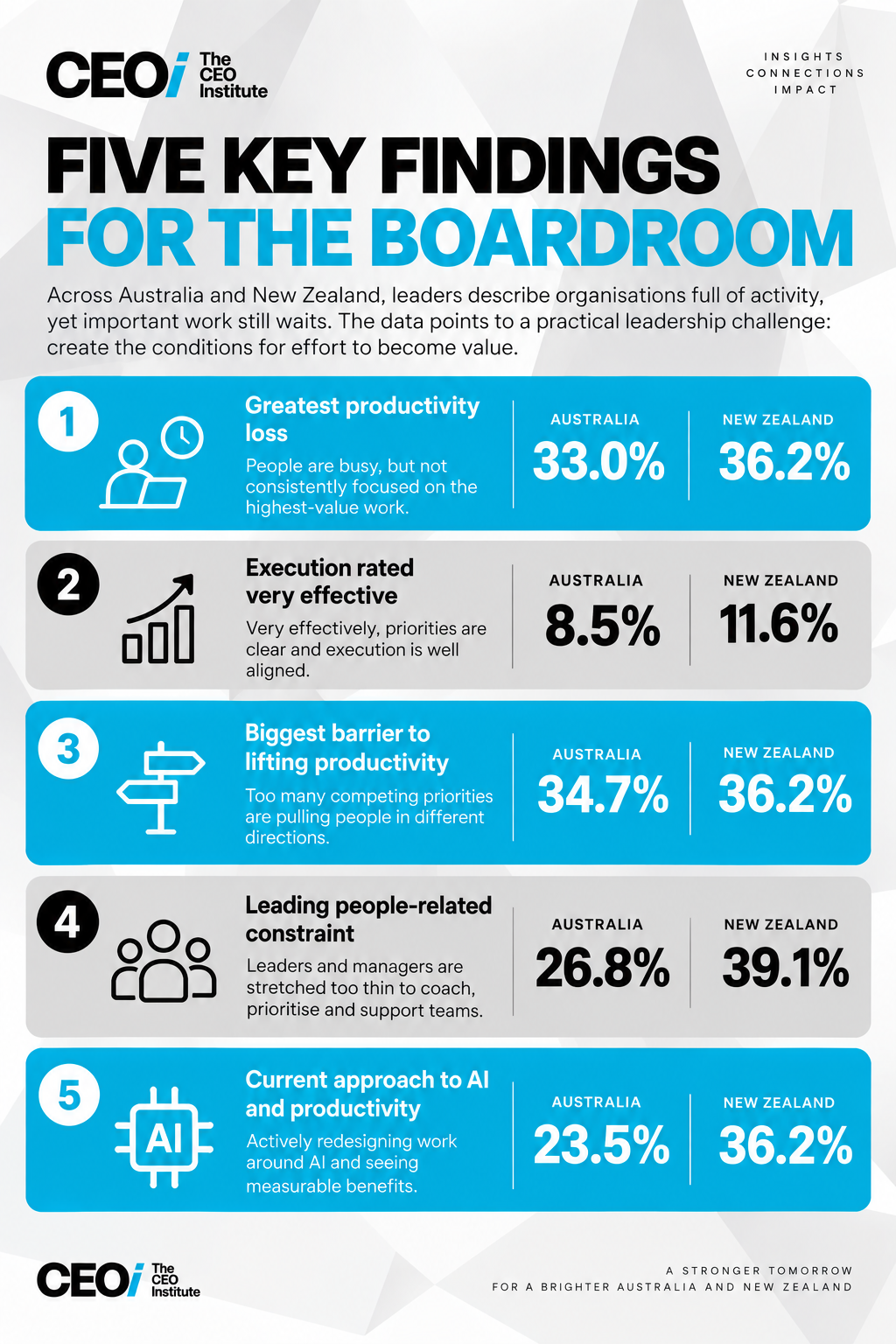
Across Australia and New Zealand, leaders describe organisations full of activity, yet important work still waits. The data points to a practical leadership challenge: create the conditions for effort to become value.
• Greatest productivity loss
° 33.0% Australia | 36.2% New Zealand
° People are busy, but not consistently focused on the highest-value work.
• Execution rated very effective
° 8.5% Australia | 11.6% New Zealand
° Very effectively, priorities are clear and execution is well aligned.
• Biggest barrier to lifting productivity
° 34.7% Australia | 36.2% New Zealand
° Too many competing priorities are pulling people in different directions.
• Leading people-related constraint
° 26.8% Australia | 39.1% New Zealand
° Leaders and managers are stretched too thin to coach, prioritise and support teams.
• Current approach to AI and productivity
° 23.5% Australia | 36.2% New Zealand
° Actively redesigning work around AI and seeing measurable benefits.
The same pressure, experienced differently
Australia and New Zealand are facing the same broad productivity challenge from different angles.
-
Australia’s most common execution response is dependence on individual leaders or teams, at 40.4%. New Zealand’s leading response is somewhat effective execution, with alignment weakening across teams or functions, at 43.5%.
-
Australia places greater weight on fragmented systems and the possible loss of human judgement through AI. New Zealand reports greater management stretch, stronger concern about falling behind competitors and a higher proportion of organisations actively redesigning work around AI.
-
Australia’s leading AI concern is losing human judgement, expertise or relationship value, at 35.8%. New Zealand’s leading concern is moving too slowly and falling behind competitors, at 44.9%.
The differences matter because they point leaders towards different starting questions.
Productivity is a leadership issue
-
Productivity is the organisation’s capacity to turn effort into value without consuming the people who create it.
-
That definition changes the conversation. It moves attention beyond hours worked, activity levels and the number of initiatives underway. It asks whether the work is moving towards the outcomes that matter, how much effort is required to keep it moving and whether the organisation can sustain that effort.
-
The next productivity frontier is the wasted work we can take out of people’s way.
-
The report follows the complete path from strategic demand to a useful result. It examines what deserves capacity, where work becomes harder than it needs to be, why execution still depends on particular people and where AI can improve the whole workflow.
-
Read the report to make work visible, decide what to stop and put released capacity to work.
Five findings for the boardroom
1. Busyness is displacing high-value work
- People are working hard, but significant effort is being spent repairing fragmented systems, reconciling information and coordinating work that should move more easily.
- A full calendar tells you that people are occupied. It does not tell you whether their attention is creating value.
2. Execution depends too heavily on individuals
- Strategy becomes fragile when delivery relies on a trusted executive, manager or long-serving employee to hold the context, make the judgement and resolve the contradiction.
- Reliable execution needs to survive absence, growth and leadership change.
3. Competing priorities are consuming capacity
- Initiatives continue to arrive, but the same managers, specialists and teams are expected to deliver all of them at once.
- The report asks leaders to make stopping, pausing and sequencing visible executive decisions.
4. Human capacity is performance infrastructure
- Management time is part of the operating model. When managers are stretched too thin, coaching, decision quality, capability development and change execution all suffer.
- Fatigue is not only a wellbeing issue. It is evidence about the sustainability of the way work is organised.
5. AI value requires redesign, judgement and trust
- AI becomes valuable when leaders redesign the workflow around a clear outcome, define accountability and protect the human expertise needed to challenge the result.
- A growing list of tools and pilots establishes activity. Changed outcomes establish value.
Use the report to make better decisions
The report is designed to help leaders move from a general sense of pressure to a clearer set of choices.
It asks:
-
Which work is consuming capacity without moving an important outcome?
-
Where does execution still depend on one person or one team?
-
What should stop, pause or be simplified?
-
Which managers or specialists have no room left to lead, coach or improve the work?
-
Which workflow is valuable enough to redesign?
-
Where must human judgement remain visible?
-
If capacity is released, where will it go?
These questions apply differently in a large enterprise and a founder-led business. The operating model may differ. The leadership choices remain recognisable.
Two ways to read The Pulse Report
The Detailed Report
The complete edition for CEOs, executives and boards who want the full analysis.
It includes the Productivity Picture, five detailed findings, Australia and New Zealand comparisons, state-level analysis across ANZ, full survey tables, The Leadership Response, the Productivity, Growth & AI Roadmap and a practical 90-day starting point.
The Executive Overview
A shorter, faster read for leaders preparing for an executive meeting, board discussion or leadership offsite.
It brings together the headline evidence, five findings, central implications, leadership agenda and roadmap in a concise format.
Both editions contain the same findings and conclusions. Choose the level of detail that suits the conversation you need to have.
Where the report leads
The report closes with the Productivity, Growth & AI Roadmap, developed in partnership with EnterpriseWorks and Cuppa.
It turns the research into a practical sequence for creating capacity, strengthening capability and converting AI investment into measurable value.
Stage 1: Sharpen Focus and Execution
Clarify value drivers, priorities, measures, ownership and execution cadence.
Sharper priorities. Stronger execution.
Stage 2: Free Up Capacity for Growth
Identify capacity loss, reduce low-value work and redirect effort towards higher-value priorities.
Higher productivity. More capacity.
Stage 3: Build a Skilled and Engaged Workforce
Build leadership capacity, future-ready skills and stronger team practices.
Stronger capability. Higher engagement.
Stage 4: Connect Secure Systems, Data and AI
Simplify workflows, connect trusted data and automate repeatable work.
Less manual work. Better decisions.
Stage 5: Accelerate Growth with an AI-Enabled Workforce
Scale AI into high-value work and reinvest freed capacity into growth and innovation.
Greater AI value. Sustainable growth.
The starting point is practical. Select one important workflow. Understand where time and judgement are being consumed. Remove unnecessary friction. Create capacity. Then decide where that capacity should go.
Productivity creates capacity. Growth begins when leaders give that capacity a destination.