


Finding the Signal in a noisy world
Finding the signal in a noisy world, five macro truths for Australian CEOs in 2026
5 min read
What Ethical Leadership Grows
Leadership has a way of exposing what is real. Not immediately, and not always in the moments we expect, but over time it becomes very difficult to hide the true nature of a leader behind polish, performance, or carefully chosen words. The pressure of leadership has a habit of revealing what is underneath.
That is why a comment made to me recently has stayed with me more than many formal leadership insights ever have. A member said, “A good tree cannot bear bad fruit, and a bad tree cannot bear good fruit.” It was one of those lines that lands with unusual force because it carries both simplicity and truth. It did not feel lofty or abstract. It felt deeply practical.
For CEOs and business owners, practicality matters. We operate in a world of competing pressures, commercial realities, and constant trade-offs. We are responsible for people’s livelihoods, for difficult decisions, for growth, for culture, for performance, and for holding a course when conditions around us are changing faster than we would like. In that environment, ethics can sometimes be spoken about as though it sits slightly apart from the real work of leadership, as though it belongs in codes of conduct, governance frameworks, or neatly written values statements while the harder business of running an organisation happens elsewhere.
I do not believe that is true.
Ethics is not separate from leadership. It is present in the way leadership is experienced by others. It lives in the small decisions, the uncomfortable conversations, the standards we hold when it would be easier not to, and the choices we make when pressure creates the opportunity to bend what we know should remain straight. Long before ethics becomes a public issue, a legal matter, or a cultural crisis, it has already been operating quietly inside the organisation through the behaviour of its leaders.
Fruit Is the Evidence
That is where the metaphor of the tree matters. In business, the fruit is the visible outcome of what has been growing beneath the surface for some time. It shows up in culture, in trust, in the quality of relationships, in how people feel after dealing with us, and in the level of confidence others place in our leadership. It shows up in whether teams feel secure enough to speak honestly, whether customers believe our word, whether partners feel respected, and whether the institution becomes stronger or more fragile over time.
These outcomes are not random. They are not disconnected from the conduct of the people at the top. They are often the direct result of what has been tolerated, rewarded, avoided, or excused. A culture of anxiety rarely appears overnight. A pattern of mistrust usually has a history. Confusion, cynicism, and high churn are often the fruit of decisions that may have seemed manageable in isolation but, when repeated over time, created an entirely predictable result.
This is why ethical leadership should never be reduced to image. It is not about appearing principled. It is about being reliable. It is about whether the people around you know what they can count on when your authority is tested. Can they trust that you will speak plainly when the situation becomes difficult? Can they trust that your standards will still apply when the stakes rise? Can they trust that you will protect the institution, not simply yourself? Can they trust that you will not suddenly change the rules when the outcome becomes inconvenient?
There is a quiet power in that kind of predictability. It creates safety, and not only in an emotional sense. It creates commercial safety as well. Organisations move more effectively when people trust the intent, judgement, and conduct of those leading them. Decisions happen faster. Communication becomes cleaner. Energy is spent building rather than second-guessing. Friction is reduced because people are not constantly scanning for hidden motives, political maneuvering, or late-arriving surprises. Trust is not soft. It is deeply operational.
How Ethical Drift Begins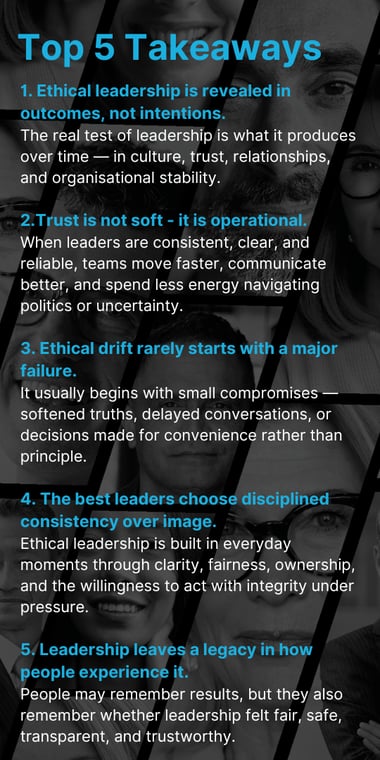
The challenge, of course, is that most ethical failures in leadership do not begin as dramatic acts of misconduct. They begin in much quieter places. They often start with rationalisation. A truth is softened because the full version may provoke a difficult response. A conversation is delayed because the timing feels awkward. A stakeholder is kept out of the loop because involving them complicates matters. A commitment is treated as flexible because circumstances have changed. A decision is defended on a technicality even though, at a human level, it leaves unnecessary damage behind.
That is how ethical drift takes hold. Not through one catastrophic moment, but through a series of permissions granted to us in the name of convenience, speed, politics, or self-protection. It happens when leaders start telling themselves that a small compromise does not really matter, that one awkward omission is harmless, or that clarity can wait until later. Yet later is often where the real cost appears. By then, trust has already been weakened, confidence has already been dented, and the fruit has already started to form.
This is one of the reasons I believe ethical leadership is less about grand declarations and more about disciplined consistency. It is built in the routine moments that may not look historic at the time. It is built when a leader chooses clarity over comfort, ownership over defensiveness, and fairness over expedience. It is built when difficult messages are delivered early rather than delayed until they become more damaging. It is built when leaders resist the temptation to hide behind complexity or process and instead say plainly what is true.
There is a noticeable difference between leaders who do this well and leaders who do not. The best leaders are not perfect, and no mature leader would claim to be. They still make mistakes. They still misjudge situations. They still have to correct course. But their posture is recognisable. They are clean in how they lead. When they get something wrong, they do not disappear into legal language, shifting explanations, or selective accountability. They own it, address it, and move. That matters more than many people realise.
By contrast, poor ethical leadership often carries a familiar feeling around it. There is usually a residue. People leave interactions uncertain, uneasy, or unusually tired. The narrative keeps changing. Accountability feels selective. Some people are expected to carry the consequences of decisions made elsewhere. The language may remain polished, but the experience of dealing with the leadership does not create confidence. Over time, people notice. Teams notice first. Then customers, partners, members, and boards do as well.
What Leadership Leaves Behind
That is why cleverness is not enough. Many leaders are highly intelligent and commercially sharp. Some are exceptionally good at explaining themselves. They can justify almost anything. They can frame self-interest as strategy, delay as prudence, opacity as complexity, and inconsistency as flexibility. In the short term, that sort of cleverness can be effective. It can buy time, avoid scrutiny, and create temporary advantage. But it rarely builds the kind of legacy that lasts.
Legacy is built differently. It is built through consistency, coherence, fairness, and trust. It is built through a way of leading that strengthens the institution rather than draining it. It is built by people whose decisions hold their shape in daylight and whose behaviour does not deteriorate when pressure rises. In the end, people do not remember only what a leader achieved. They remember what it felt like to be led by them. They remember whether the culture felt safe or political, fair or selective, clear or evasive. They remember the fruit.
For CEOs and business owners, that creates a useful challenge. It asks us to stop looking only at what we intended and start looking more honestly at what our leadership is producing. If there is repeated confusion in the organisation, something is feeding it. If distrust is rising, something has weakened. If people are becoming cynical, something has been inconsistent. If the culture feels tense and guarded, that does not happen without cause. The fruit may not tell us everything, but it tells us enough to know whether the tree is healthy.
There is also something hopeful in that. Trees can be tended. Cultures can be repaired. Leaders can change. Organisations can recover from drift when there is enough honesty to admit what has been growing and enough courage to address it properly. But that process begins only when we stop managing appearances and start examining the root.
That is what I took from that quote from our member. I now know it’s a biblical quote but equally I know it’s not a poetic thought just for the week, but a standard worth carrying into every consequential decision.
“A good tree cannot bear bad fruit, and a bad tree cannot bear good fruit.” Leadership is revealed in what grows around us. It is revealed in the quality of trust, in the strength of relationships, in the calm or instability of culture, and in the experience people have on the other side of our decisions.
So perhaps the question for any leader is not whether we think of ourselves as ethical. The more useful question is far more concrete than that.
What is our leadership growing, and what does that reveal?
Finding the signal in a noisy world, five macro truths for Australian CEOs in 2026
Cash flow is no longer a finance issue — it's a CEO-level strategic priority.
.png)
Cash flow is no longer a finance issue — it's a CEO-level strategic priority.