
Skip to the main content.

4 min read

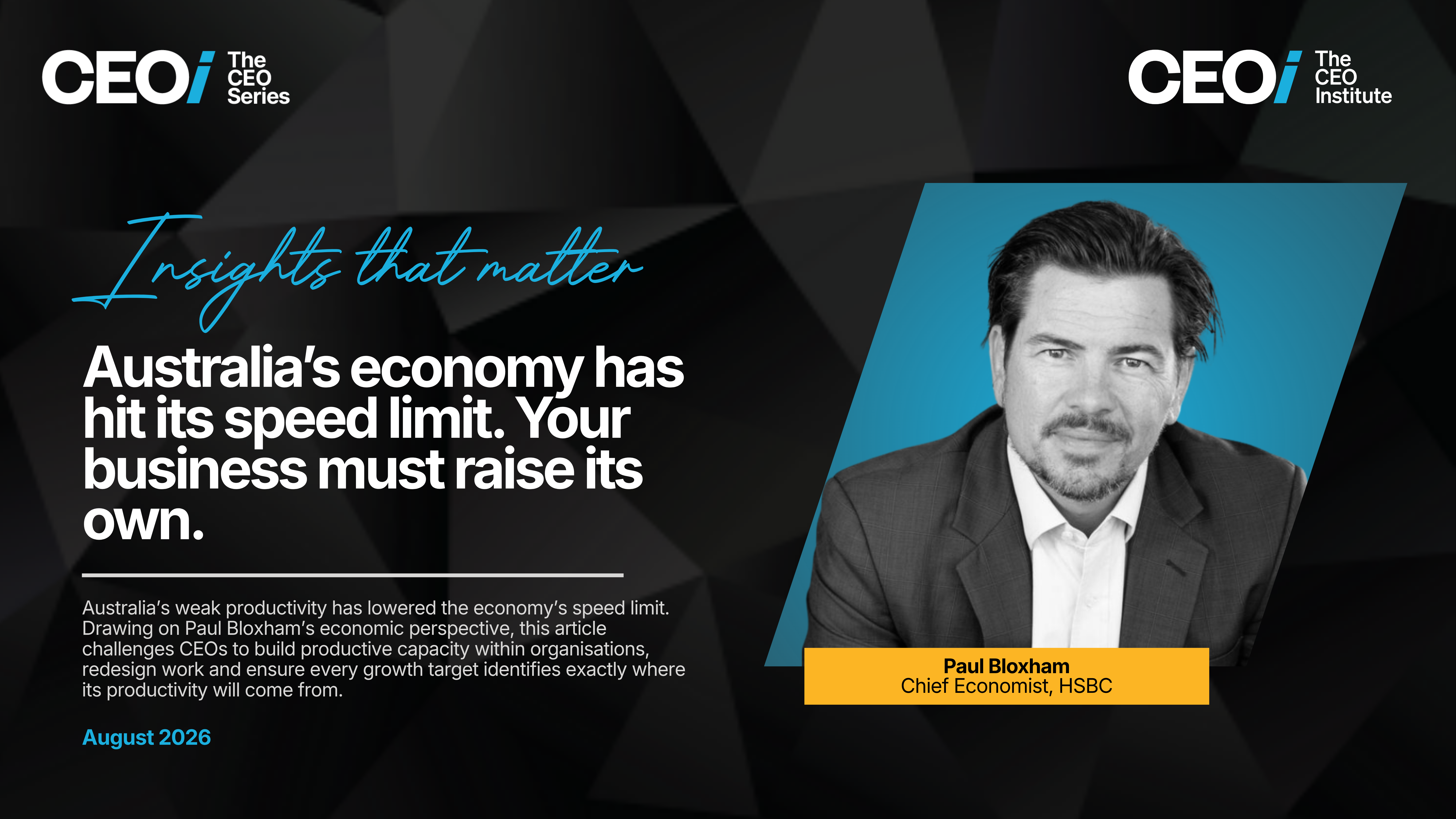
Australia’s economy has hit its speed limit. Your business must raise its own.

Australia’s economy has hit its speed limit. Your business must raise its own.


Australia’s economy has hit its speed limit. Your business must raise its own.

At our “Connect: Unlocking Productivity” events in Sydney and Melbourne, Paul Bloxham, Chief Economist at HSBC Australia offered a simple explanation for one of Australia’s most persistent economic problems. The country is not short of demand. It is short of the productive capacity needed to meet that demand without creating higher prices.

Australia’s labour productivity growth has averaged about 0.3% a year over the past decade, compared with around 1.3% in the decade before it. Over much of the same period, US output per hour moved materially higher while Australia’s barely advanced. Paul’s conclusion is uncomfortable: weak productivity has lowered the economy’s sustainable “speed limit” to below 2%.

That changes the meaning of growth. A modest lift in activity can now push demand beyond what the economy can supply, reigniting inflation and forcing the Reserve Bank to respond. The RBA’s decision on 11 August, made the day before our Melbourne event, to hold the cash rate at 4.35% after three increases this year was a pause, not an all-clear. Inflation remains too high, productivity remains weak and the economy still needs a period of subdued growth to relieve capacity pressure.


The same equation is operating inside your business

CEOs often treat productivity as a national policy problem and the economy as a backdrop they must work around. Paul’s analysis points to a more immediate conclusion. Many organisations should also focus on fixing the supply-side problems inside their own operating models.

When sales, customer demand or strategic priorities grow faster than an organisation’s capacity to deliver, its own form of inflation appears. Vacancies become more expensive to fill. Overtime rises. Work queues lengthen. Managers add meetings and reporting to regain control. Quality slips, rework grows and margins absorb the cost.

Many growth plans quietly assume that the existing operating model can continue with more people, more hours and more capital. That is expansion through additional inputs. If 10% more revenue requires 10% more labour, management time or operating cost, the business has grown, but it has not become more productive.

Productive growth changes that equation. It creates more value from each hour worked, each dollar invested and each asset already in the business. In an economy with scarce labour, high capital costs and persistent inflation, that capability becomes the price of sustainable growth.


Build your own supply side

Governments influence national productivity through regulation, tax, competition, housing, energy and infrastructure. Those reforms matter, but no CEO controls their scope or timing. Waiting for the policy environment to improve leaves a critical source of capacity untouched.

Every organisation has its own supply side. It sits in how work moves across functions, how quickly decisions are made, how well systems and data connect, where authority rests, which skills are available and how much human effort is consumed by low-value activity.

The most useful question for a leadership team is therefore not, “How much do we want to grow?” It is, “Where will the capacity for that growth come from?”

If the answer is predominantly more headcount, harder work or another management layer, the strategy already contains a capacity deficit. The CEO’s task is to find the constraint that will prevent the next unit of growth, then redesign the work around it. That may mean shortening an approval path, eliminating duplicated handling, fixing poor data at its source, changing a role boundary or removing a process that exists only because another process is broken.


AI must change the production equation

Paul identified technology, and particularly AI, as one of the clearest potential sources of a productivity lift. Australia has historically been better at adopting technology than inventing it. That creates a genuine opportunity, provided adoption produces a measurable operating gain.

The distinction matters. An AI licence is an input. A pilot is activity. Even widespread employee use does not prove that the organisation has become more productive. The economic value arrives when AI reduces the time, labour, error or capital required to produce a business outcome.

That is why AI should begin with a constraint, not a tool. Choose a small number of workflows where cycle time, cost-to-serve, decision quality or customer responsiveness materially limits growth. Redesign the workflow, apply the technology and remove the old work that the new process makes unnecessary. Otherwise, AI adds another layer of systems, checking and governance while the underlying process remains intact.

The global investment boom in data centres reveals the same paradox at a larger scale. AI investment can add to demand and capacity pressure before its productivity benefits arrive. Inside an organisation, an ambitious AI program can consume capital, leadership attention and scarce capability well before it improves output. CEOs need to govern the path from investment to realised capacity, not celebrate adoption as the result.


Change the growth conversation

Most executive and board reporting tracks revenue, margin, headcount, cash and delivery. Those measures show what the business produced and what it cost. They rarely reveal whether the underlying capacity to produce has improved.

Every material growth target should therefore name its productivity source. A leadership team should be able to state which constraint will move, how output per hour or dollar will change, when the capacity will become available and where the benefit will be reinvested.

For one organisation, that may mean more customers supported per service team without lowering quality. For another, it may mean fewer engineering hours per release, faster stock turns, shorter approval times or more revenue generated for each hour of management attention. The metric must connect operating change to economic value.

As Paul suggested, a slower economy makes this discipline more urgent. Softer demand may temporarily reduce pressure, but it does not repair the organisation’s production system. Businesses that respond only with blunt cost reduction risk removing capability while leaving the friction intact. Businesses that redesign work can protect margins now and create capacity for the next upswing.

CEOs cannot set interest rates, rewrite regulation or repair national infrastructure. They can decide whether their organisations respond to a lower-growth economy by reducing ambition or raising productive capacity.

Paul’s economic message is clear. Australia may need to grow more slowly because its supply side is too weak to support anything faster without inflation. The leadership response is equally clear: strengthen the supply side of your own business. In a low-speed economy, the organisation that can grow without a proportional rise in people, hours and cost holds the decisive advantage.