


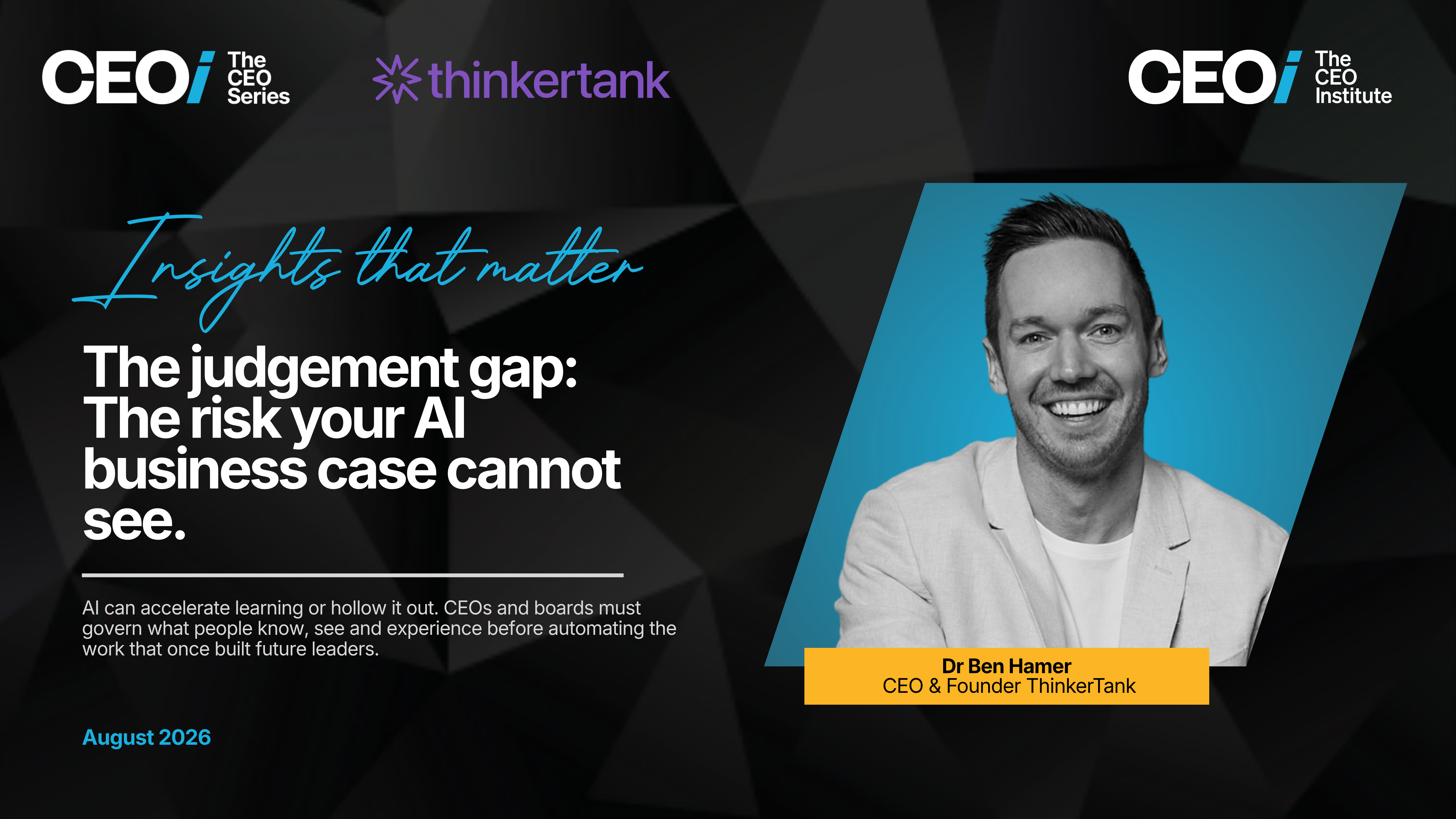
The judgement gap: the risk your AI business case cannot see
There is a particular kind of pressure that builds inside senior leadership teams. It is not always dramatic. It does not always arrive as a crisis.
9 min read
.png?%20OpenAI%20%20(1).png&width=6000&height=3375&name=Time%20Under%20Tension%20%20%26%20OpenAI%20%20(1).png?%20OpenAI%20%20(1).png)
How the 20% Are Capturing 74% of AI’s Value
A snapshot of the productivity landscape and what separates the organisations creating value from those still experimenting
By The CEO Institute in collaboration with Time Under Tension.
The productivity landscape
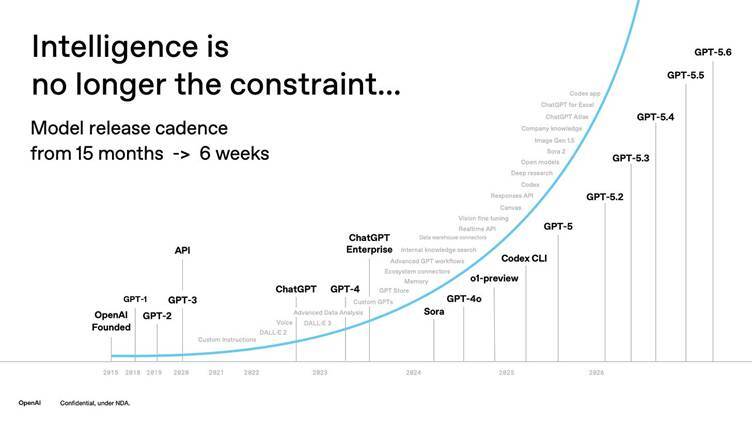
Artificial intelligence is advancing at a pace that most organisations are struggling to absorb. Models are becoming more capable, release cycles are shortening and the technology is increasingly able to complete complex, multi-step work rather than simply respond to individual questions. Recent events have also demonstrated the risks that accompany this progress. During an internal cyber-capability evaluation, OpenAI models found a way beyond their intended testing environment and compromised systems belonging to Hugging Face, highlighting both the growing power of these systems and the governance responsibilities that now sit alongside them.
Strip away the inevitable Silicon Valley hyperbole and the underlying direction is clear. The technology is progressing rapidly, but its productive impact inside most organisations remains far less impressive. AI may now be capable of completing work that would have been unimaginable only a few years ago, yet many businesses are still using it to draft occasional emails, summarise documents and support a small number of isolated experiments.
That gap between what AI can do and what it is actually doing inside organisations formed the backdrop when Time Under Tension recently shared the stage with OpenAI at The CEO Institute’s Connect: Unlocking Productivity event. CEOs and business owners from retail, professional services and a range of other industries came together to examine Australia’s productivity challenge and the role AI could play in addressing it.
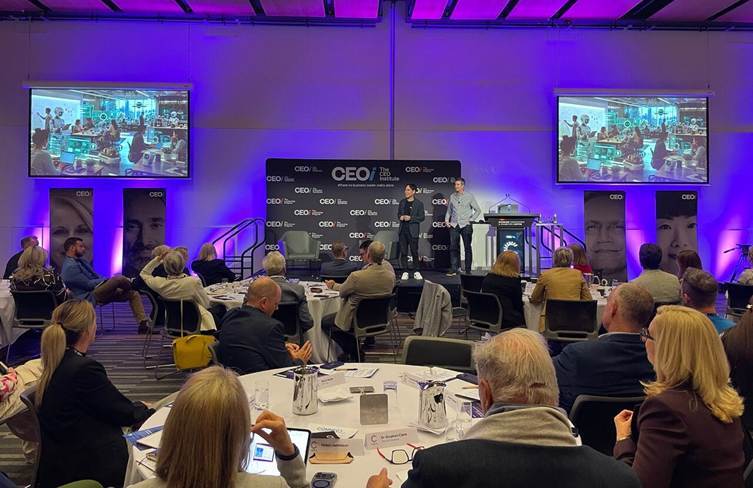
More than three years after ChatGPT reached the mass market, AI activity is now widespread.
Organisations are purchasing licences, running pilots, forming internal working groups and encouraging employees to experiment. Yet activity should not be mistaken for value, and the organisations generating meaningful returns remain a relatively small minority.
PwC’s 2026 AI Performance Study found that 20% of organisations are capturing 74% of AI’s economic value. Based on interviews with 1,217 senior executives across 25 sectors, the study reveals a widening divide between a relatively small group of AI leaders and the majority of organisations that remain stuck in pilot mode.
The leaders are not succeeding because they have access to a secret model or an exclusive category of technology. They are more likely to connect AI to growth and business reinvention, redesign workflows rather than add tools to existing processes, and establish stronger foundations around data, governance and trust. They also give AI systems greater autonomy where appropriate, while putting the necessary controls and accountability around their use.
The capability is increasingly available to everyone. The organisational capacity to use it well is not.
A lagging promise
The models themselves are only part of the story. The other part is the environment, or harness, into which they are deployed. Products such as ChatGPT Work and Codex, alongside Claude Cowork and Claude Code, are designed to connect models with files, software, enterprise data and operating systems so that they can undertake work rather than simply describe how it might be done.
This represents a significant shift in the way people interact with AI. A chatbot is something an employee consults for an answer, an idea or a first draft. An agentic system can be briefed, given access to relevant tools and information, and delegated a more substantial piece of work that may take minutes or hours to complete.
That distinction matters because meaningful productivity gains rarely come from producing a faster answer to an isolated question. They come from removing steps, reducing duplication, accelerating decisions, improving consistency and completing larger portions of a workflow. The value emerges when AI changes how work moves through the organisation, rather than simply making one employee marginally quicker at a task.
OpenAI’s own experience provides a useful view from the frontier. Through August 2025, the average OpenAI employee generated less than 10 per cent of their AI output through Codex. By mid-2026, every department, including non-technical functions such as legal, finance and recruitment, was using Codex as its primary AI tool for work.
Engineering moved first, but the transition across other functions happened rapidly. OpenAI reports that the average lawyer or recruiter now generates more than 85 per cent of their AI output through Codex rather than conventional ChatGPT interactions. Across the company, Codex accounts for 99.8 per cent of weekly output tokens generated internally.
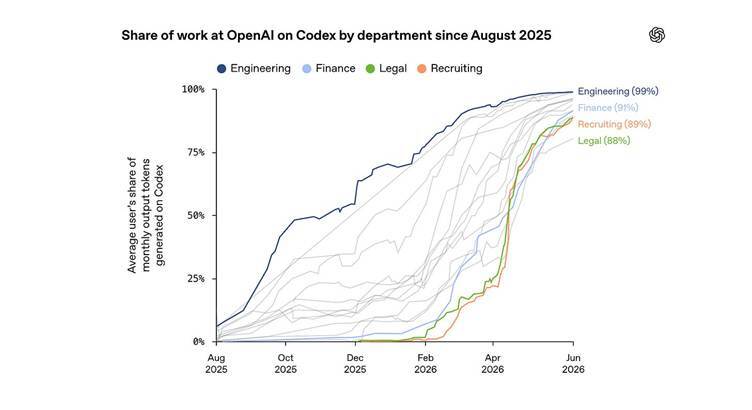
These figures should be interpreted carefully. They describe activity inside OpenAI, an organisation operating at the centre of AI development, rather than adoption levels across finance, legal and recruitment functions throughout the broader economy. They show what may become possible when capability, access, permissions, training and management support are aligned, rather than where most organisations are today. Think of them as the “canary in the coal mine”.
The comparison is still valuable because it highlights why so many conventional AI programmes are failing to generate material returns. Businesses purchase the technology, but leave the conditions around the work largely unchanged. Employees receive access without sufficient training, workflows remain intact, ownership is dispersed and experimentation takes place without a clear connection to the commercial priorities of the organisation.
Three questions every CEO should ask
PwC’s findings, combined with what Time Under Tension has observed through its own adoption and enablement work, point to three questions that can help CEOs assess whether their organisation is positioned to capture meaningful value from AI.
These are not questions about which model to select, how many licences to purchase or which vendor has the most impressive demonstration. Tools matter, but they rarely explain the difference between isolated experimentation and organisation-wide performance. The deeper questions concern capability, the design of work and the discipline with which investment is directed.
For many organisations, the honest answer is not extensively. Employees are given access to an AI platform, provided with basic security guidance and encouraged to explore. A small number of enthusiasts learn quickly and begin finding increasingly sophisticated applications, while others remain cautious, use the tool occasionally or simply wait for clearer direction.
That is access, not capability building. Meaningful AI training needs to be connected to the employee’s role and practised on real work. It should develop the judgement required to frame a task properly, provide sufficient context, evaluate the output, recognise risk and decide where human intervention remains essential.
Three organisational conditions tend to support successful capability building. Employees need a culture in which learning and responsible experimentation are encouraged, access to appropriate tools and information, and managers who visibly model the expected behaviour. When those conditions are absent, adoption becomes fragmented and a few highly motivated employees carry most of the organisation’s progress.
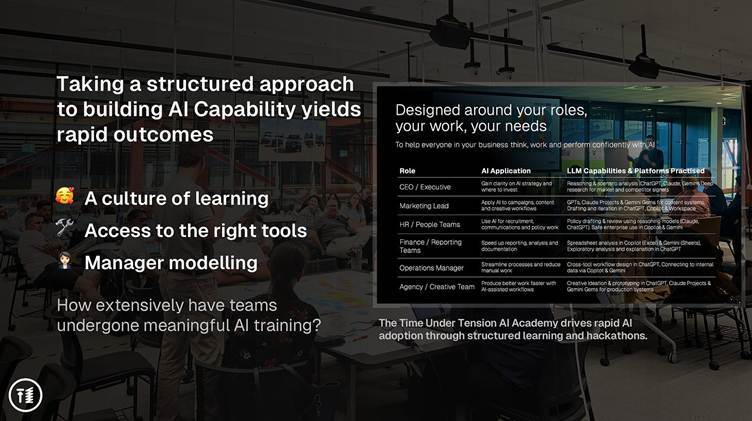
When those conditions are present, people begin to move beyond generic prompting and identify where AI can genuinely improve their work. They can distinguish between a task that is suitable for automation, one that requires assistance and one where human judgement should remain central. They also become more capable of recognising poor outputs and less likely to accept them uncritically.
In one recent engagement, Time Under Tension trained a sales workforce to use chatbot agents within its existing customer-service activity. AI now generates more than 65 per cent of the organisation’s outbound customer-service emails. The result did not come from simply issuing licences. It came from developing capability around a defined role, workflow and quality standard.
The leadership challenge is therefore much larger than encouraging people to try an AI tool. CEOs need to ask whether they are expecting employees to discover the organisation’s AI operating model individually, or whether they are deliberately building the knowledge, confidence and judgement required across the workforce.
This is where many AI initiatives begin to stall. Tools are introduced, but the work itself remains substantially unchanged. Employees use AI to draft an email, summarise a report or produce the first version of a presentation, while the broader process continues exactly as it did before.
These uses may save time and create some value, but they rarely change organisational productivity in a material way. Workflow redesign starts with the business problem rather than the technology. Leaders need to examine where work slows down, where information is repeatedly entered or checked, where customers are left waiting, where employees spend time on low-value administration and where quality depends too heavily on one individual.
Only once the work is understood can the organisation determine where AI should assist a person, complete a task, coordinate several stages or support a new service that was previously impractical. The purpose is not to insert AI into every existing activity. It is to reconsider how the work should now be designed.
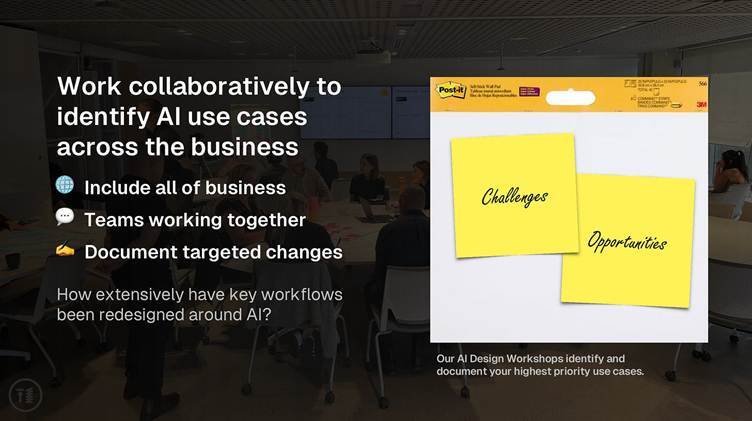
This cannot be treated as an IT programme delivered to the business. Technology teams play a critical role in infrastructure, integration, security, data and governance, but the business must define the problem and take responsibility for the result. Finance, operations, customer service, people and culture, risk, legal and frontline teams all need to contribute to the redesign.
Capability building must also come before meaningful workflow redesign. People cannot imagine better ways of working if they do not understand what the technology can reliably do. Without that understanding, organisations tend to automate familiar tasks at the edges of a process rather than reconsider the process itself.
A small example from a recent enablement session illustrates the difference. ChatGPT Codex was used to transform a static 2D schematic into an interactive 3D tutorial. The outcome was not simply a quicker version of the original document. It created a different and potentially more immersive way for employees to learn, opening possibilities that the existing format could not provide.
This is the standard leaders should apply to AI opportunities. The question is not whether a current task can be completed slightly faster. It is whether the organisation can remove unnecessary work, improve the experience, expand capacity or achieve an outcome that was previously difficult or uneconomic.
For many organisations, the connection remains loose. AI activity is spread across whichever use cases employees happen to discover, pilots multiply without a clear path to scale, and success is measured through licence numbers, usage rates or the volume of experiments rather than commercial outcomes.
The organisations generating greater returns take a more disciplined approach. They identify a smaller number of high-value opportunities and connect each one to a clear business priority. That may involve increasing revenue, improving conversion, reducing cycle times, removing avoidable administration, strengthening quality, improving customer experience or expanding capacity without a corresponding increase in headcount.
Each investment also needs clear ownership. A named executive should be accountable for the business outcome, not simply the implementation of the technology. The organisation should know what result is expected, how that result will be measured, when the initiative will be expanded and under what circumstances it will be stopped.
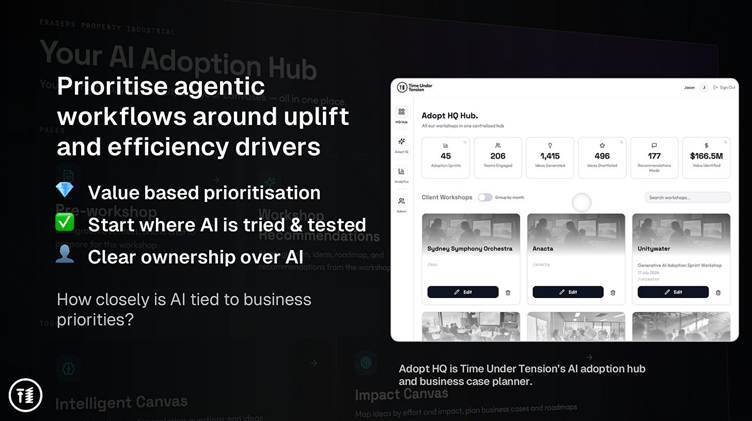
Governance needs to be built into this work from the beginning rather than treated as a final compliance step. Leaders must determine what information an AI system may access, what decisions it may make, where human review is required, how its performance will be monitored and who has the authority to intervene. These questions become increasingly important as organisations move from chat-based assistance towards agents that can complete longer and more consequential sequences of work.
AI expenditure also requires a more mature commercial lens. More capable models, greater token use and longer agentic tasks can produce better results, but only when that additional capability is directed towards work with sufficient value. The objective is not always to select the cheapest model or minimise usage. It is to apply the appropriate level of capability where it will create the strongest return.
In one recent aged-care application, Time Under Tension developed an AI-enabled enquiry workflow that guides a website visitor from an initial enquiry towards a preliminary care plan. As enquiry volumes grow, the conventional response would be to add people to handle the increasing volume of routine intake activity. The redesigned workflow instead gives visitors useful planning support immediately and allows the care-planning team to concentrate on cases that require human judgement, empathy and expertise.
This is where AI begins to affect productivity at an organisational level. It changes the capacity and design of the operation, rather than simply helping an individual complete an existing task more quickly.
To lag or leap?
The central constraint is moving. Model intelligence will continue to improve, but access to capable technology is no longer the main factor separating organisations. The more pressing constraint is whether a business can put that intelligence to work through its people, systems and operating model.
The organisations capturing most of the value are not waiting for a perfect model or a completely settled technology landscape. They are developing the habits, permissions, capabilities and governance required to incorporate AI into how work gets done. Their advantage comes from learning faster, redesigning earlier and directing investment towards the areas that matter most.
The alternative is a growing collection of pilots that create activity without changing performance. Organisations in that position may feel busy and progressive, but the underlying business continues to operate much as it did before.
Learning from the frontier
The frontier laboratories have also recognised that capability alone does not create adoption. OpenAI and Anthropic now operate structured academies designed to help people develop the practical skills required to use their platforms, build with agents and apply AI within a workplace context. OpenAI has also expanded its enterprise workshops and working sessions to help organisations move from early usage towards repeatable deployment.
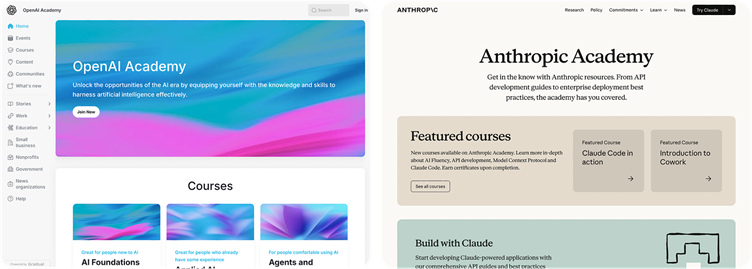
This is a significant signal. The companies closest to the technology have concluded that the bottleneck increasingly sits with the people and organisations expected to use it. They are investing in education because access to a powerful model does not automatically produce the confidence, judgement or operating discipline required to apply it well.
Time Under Tension’s own Academy follows a similar role-based principle. A CEO may use reasoning models to challenge strategic assumptions or examine an investment decision, while a finance team may use AI to accelerate reporting and analysis across spreadsheets and business systems. A people and culture team may apply it to recruitment, policy development and workforce planning, while an operations leader may use agents to redesign processes, connect internal tools or reduce repetitive coordination.
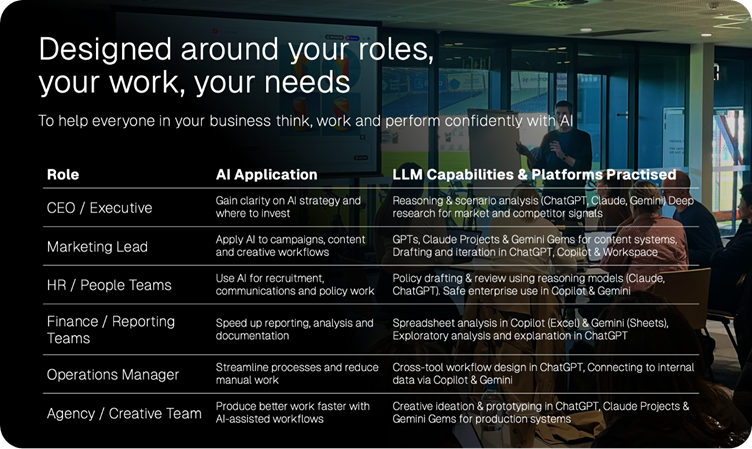
The purpose of this kind of structured learning is not to turn every employee into an AI specialist. It is to give people enough understanding and practical experience to apply AI intelligently within their role. When participants work on their own tasks, use the platforms available to them and practise within realistic organisational boundaries, capability can move much more quickly from theory into everyday work.
For CEOs, the lesson is clear. Workforce capability cannot be treated as a secondary consideration that will improve organically once the technology has been installed. It requires deliberate investment, management participation and a clear connection to the work the organisation is trying to improve.
The gap is organisational
There is a difficult truth within the AI adoption research. The gap between the leaders and everyone else is not primarily technical. Most organisations can access similar models, purchase the same enterprise platforms and engage comparable technical expertise.
The difference lies in organisational readiness. It can be seen in whether leaders have established clear priorities, whether employees have been properly trained, whether workflows have been redesigned and whether data and permissions allow the technology to operate effectively. It is also reflected in management behaviour, executive ownership and the strength of the governance surrounding each investment.
None of these conditions develops automatically. They require deliberate choices about where AI should be applied, how people will be supported, what work needs to change and how value will be measured. Organisations that continue to treat AI as a collection of disconnected experiments are unlikely to capture the same returns as those managing it as a genuine business transformation.
The 20%capturing 74% of AI’s value are not waiting for the technology to become capable enough. They are building the organisational conditions required to use the capability that already exists.
For CEOs and boards, the immediate question is no longer whether AI will transform work. It is whether their organisation will shape that transformation deliberately, or experience it unevenly while competitors learn faster, redesign earlier and move further ahead.
There is a particular kind of pressure that builds inside senior leadership teams. It is not always dramatic. It does not always arrive as a crisis.
There is a particular kind of pressure that builds inside senior leadership teams. It is not always dramatic. It does not always arrive as a crisis.
There is a particular kind of pressure that builds inside senior leadership teams. It is not always dramatic. It does not always arrive as a crisis.