
Skip to the main content.

5 min read

The Productivity Imperative

The Productivity Imperative


The Productivity Imperative: Why CEOs Must Rethink How Work Gets Done

Productivity has moved from an economic debate to a boardroom issue. For years, it has been discussed through the language of national accounts, labour inputs, output per hour and multifactor productivity. Those measures matter because they shape wages, living standards, investment, competitiveness and economic resilience. Yet for CEOs and business owners, productivity now feels much more immediate. It shows up in the work that slows the business down, the meetings that crowd out thinking time, the reports that track activity without improving decisions, and the technology investments that promise efficiency but often add another layer of process.

Across Australia and New Zealand, the productivity challenge is not abstract. Australia’s Productivity Commission has reported that market sector multifactor productivity declined by 0.5% in 2024–25, while the Australian Bureau of Statistics has noted that labour productivity in the June quarter of 2025 was roughly back at pre-pandemic levels. In New Zealand, Stats NZ reported that labour productivity rose 0.8% in the measured sector in the year ended March 2025, while multifactor productivity fell 0.9%. These figures tell a clear story: productivity improvement is proving difficult, uneven and far from guaranteed. [1] [2] [3]


The CEO reality: growth, cost and digital pressure are colliding

The challenge for CEOs is that productivity is not arriving as a standalone problem. It is arriving at the same time as stubborn cost pressure, cautious customer demand, technology disruption, labour constraints and increased expectations from boards, investors, employees and customers. Leaders are being asked to grow, protect margin, invest in digital capability and keep their people engaged, often with limited slack in the system.

The CEO Institute’s Pulse Report, based on 798 leaders across Australia and New Zealand, captured this tension clearly. Across ANZ, 42.6% of leaders nominated growth and expansion as their top internal priority, 22.9% selected cost management and efficiency, and 21.2% chose innovation and digital transformation. Externally, the leading pressures were inflation and cost pressures, consumer demand slowdown and technology disruption. [4]

This is the leadership reality of 2026. CEOs are not choosing between growth, cost and digital change. They are trying to deliver all three. Productivity, therefore, cannot sit only with operations, finance, technology or HR. It must sit with the CEO because it is fundamentally about how the organisation creates value.


Productivity cannot be solved through cost-cutting alone

Cost discipline matters. Every business needs to understand where resources are being wasted, where effort is duplicated, and where costs are no longer connected to value. But when productivity is reduced to a cost-cutting exercise, the organisation can become leaner without becoming stronger. It may reduce headcount, cut discretionary spend or slow investment, while leaving the deeper causes of underperformance untouched.

The more important question is not simply where cost can be removed. The more important question is how work actually gets done. In many organisations, work moves through a complex web of meetings, approvals, dashboards, handovers, systems, spreadsheets, informal workarounds and inherited processes. Some of that work is essential. Some of it protects quality, manages risk, builds trust or enables coordination. Some of it is waste. Some of it was once useful but has outlived its purpose.

The productivity challenge is that many organisations do not have a clear enough view of the difference. They can measure activity more easily than value. They can see whether a task has been completed, but not always whether it was worth doing. They can see that people are busy, but not whether that busyness is translating into better decisions, stronger execution, improved customer outcomes or more profitable growth.


The work needs to be understood before it can be redesigned

Productivity improvement starts with understanding the flow of work through the business. Where does strategy lose clarity as it moves through layers and functions? Where are teams working hard on priorities that no longer matter? Where does rework happen? Which decisions take too long? Which systems create manual effort or duplicate reporting? Which leaders are spending their time coordinating work that the operating model should make simpler?

These questions are often treated as operational housekeeping. They are not. They are strategic questions because they determine whether the business can scale, whether the strategy can be executed, whether AI can be adopted effectively and whether people can sustain performance without burning out.

A CEO who wants to improve productivity must move beyond the assumption that more effort will produce better outcomes. In many businesses, people are already working hard. The issue is whether the design of work allows their effort to become value. If the answer is no, then asking for more pace, more output or more accountability will only compound the pressure.


AI will only unlock productivity if the work is ready for it

AI has made the productivity conversation more urgent, but it has also made it more dangerous. The opportunity is significant. AI can analyse information, produce first drafts, improve decision-making, automate repeatable tasks, surface insights and help people spend more time on higher-value work. Microsoft’s 2026 Work Trend Index found that 66% of surveyed AI users said AI allowed them to spend more time on high-value work, while 58% said they were producing work they could not have produced a year earlier. [5]

The risk is assuming that AI creates productivity by default. It does not. If a process is unclear, AI can accelerate confusion. If data is fragmented, AI can expose the weakness rather than solve it. If accountability is vague, AI can generate more output without improving outcomes. If leaders use AI only as a cost extraction tool, they may miss the bigger opportunity to redesign work around better judgement, better flow and better value creation.

Microsoft’s report also makes a critical point for leaders: organisational factors such as AI culture, manager support and talent practices accounted for more than twice the reported AI impact of individual mindset and behaviour. That should matter to every CEO. It means AI-enabled productivity is not simply a technology adoption problem. It is an operating model, leadership, management and capability problem. [6]


Leaders need to protect the value they cannot easily measure

There is another risk in the productivity conversation that deserves more attention. Not all friction is waste. Not all repetitive work is low-value. Not all human overlap is inefficiency. Some work that looks slow from the outside is where people build judgement, expertise, relationships and organisational memory. Remove it too quickly and the organisation may look more efficient while becoming more fragile.

This matters because many productivity efforts focus on what is visible and measurable. Time saved. Roles removed. Costs reduced. Processes automated. Those measures are useful, but they do not capture everything that makes a business perform. Trust, judgement, craft, culture, customer intimacy, leadership confidence and institutional knowledge are harder to measure, but they are often the things that separate a resilient organisation from a brittle one.

The task for CEOs is to pursue productivity without hollowing out the capability that future performance depends on. That requires a more thoughtful approach to automation, workforce planning and work redesign. Leaders need to understand which tasks are genuinely low-value, which tasks build capability, which tasks require human judgement and which tasks can be safely supported or performed by technology.


Productivity is a growth discipline

The organisations that make real progress on productivity will not be those that simply push their people harder or cut their cost base faster. They will be the ones that redesign how work gets done. They will connect strategy to execution more clearly, reduce unnecessary complexity, improve the quality and speed of decision-making, strengthen management discipline and apply technology where it can genuinely expand organisational capacity.

Productivity should be treated as a growth enabler, not simply a cost-reduction exercise. Done well, it gives people more time for the work that matters. It improves customer experience. It strengthens execution. It increases the return on technology investment. It helps leaders protect margin while still investing in the future.

For CEOs and business owners, the imperative is clear. Understand how work flows through the organisation. Look beyond activity and focus on value. Treat AI as a catalyst for work redesign, not a shortcut to transformation. Build managers who can translate strategy into daily execution. Protect the human judgement and capability that make performance durable.

The next productivity gain will not come from asking people to work harder inside systems that are already stretched. It will come from designing work better.


[1] Australia’s Productivity Commission reported that market sector multifactor productivity declined by 0.5% in 2024–25.
[2] The Australian Bureau of Statistics noted that, in the June quarter 2025, Australia’s labour productivity was roughly at pre-pandemic levels, similar to December quarter 2019.
[3] Stats NZ reported that labour productivity rose 0.8% in the measured sector in the year ended March 2025, while multifactor productivity fell 0.9%.
[4] The CEO Institute’s Pulse Report was based on 798 leaders across Australia and New Zealand and identified growth, cost management and innovation or digital transformation as the top internal priorities.
[5] Microsoft’s 2026 Work Trend Index reported that 66% of AI users said AI allowed them to spend more time on high-value work, while 58% said they were producing work they could not have produced a year earlier.
[6] Microsoft’s 2026 Work Trend Index found that organisational factors accounted for more than twice the reported AI impact of individual mindset and behaviour.

Productivity is Now a Design Question

4 min read

Productivity is Now a Design Question

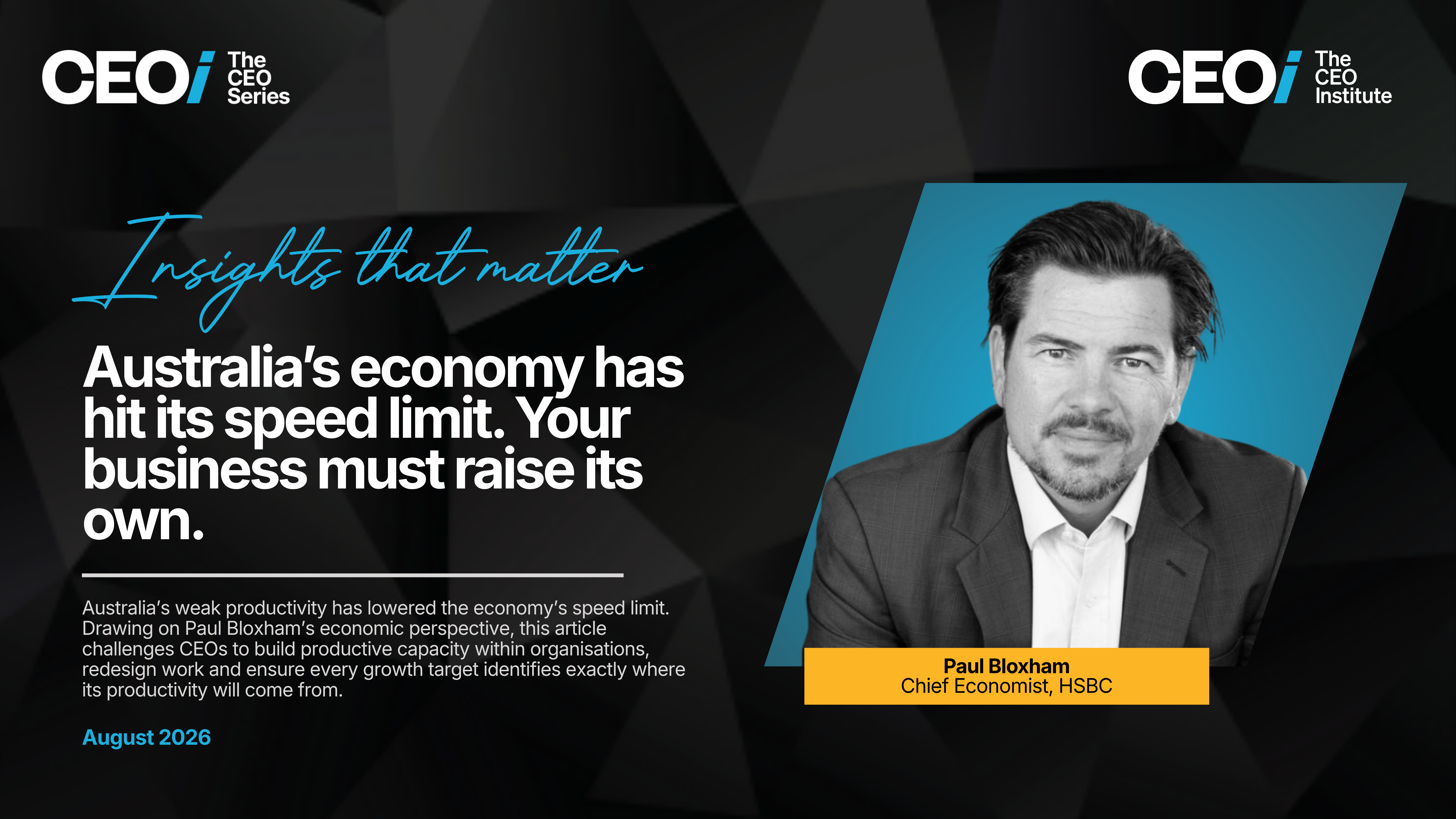
How CEOs are redesigning work, decision-making and capability for the next era of performance For many CEOs, productivity has moved from an economic...
Read More
The CEO Playbook for Talent: Great People Stay Where the Team Is Strong

6 min read

The CEO Playbook for Talent: Great People Stay Where the Team Is Strong

The CEO Playbook for Talent: Great People Stay Where the Team Is Strong Across The CEO Institute’s Talent Series, delivered in association with...

Read More
Top Social Procurement Trends in Australia

8 min read

Top Social Procurement Trends in Australia

$1.4 billion and accelerating: why social procurement has moved from compliance to competitive advantage For many CEOs, procurement has...

Read More