
4 min read
Australia’s economy has hit its speed limit. Your business must raise its own.
Australia’s economy has hit its speed limit. Your business must raise its own. At our “Connect: Unlocking Productivity” events in Sydney and...
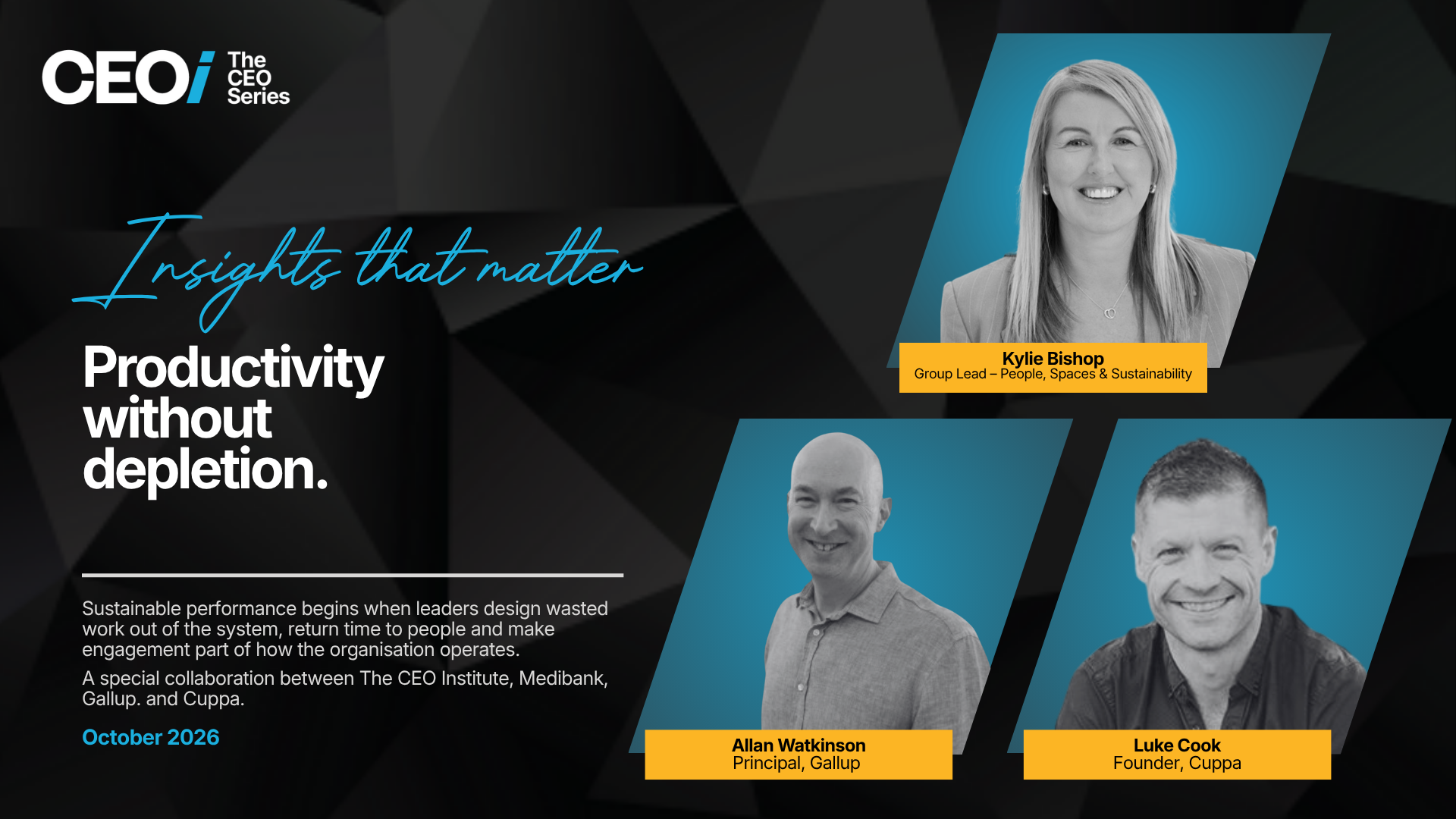
Productivity without depletion
Sustainable performance begins when leaders design wasted work out of the system, return time to people and make engagement part of how the organisation operates.
A special collaboration between The CEO Institute and Kylie Bishop, Chief People Officer at Medibank, and Allan Watkinson, Principal at Gallup. Facilitated by Luke Cook, Founder and CEO of Cuppa, at “Connect: Unlocking Productivity” in Melbourne.
Australia's productivity challenge is usually discussed through the language of economics, technology and investment. Those levers matter, but they can obscure the place where productivity is experienced every day: inside the work itself. The Productivity Commission reported that labour productivity fell 0.6% in the March 2026 quarter and grew by only 0.3% across the year. At the same time, employees are navigating expanding workloads, constant interruption and pressure to absorb another wave of change.
That tension shaped one of the most human conversations at The CEO Institute's Connect: Unlocking Productivity event in Melbourne. Facilitated by Cuppa founder and CEO Luke Cook, the panel brought together Kylie Bishop, Chief People Officer at Medibank, and Gallup principal Allan Watkinson. Their discussion challenged a deeply embedded assumption: that productivity improves when leaders extract more effort from people.
The better question, Luke argued, is not how to make people do more. It is what is getting in the way of people doing their best work. That shift takes productivity out of the realm of employee effort and places it where it belongs, in the design of work and the choices made by leaders.
When effort becomes the shock absorber
Many organisations have allowed human effort to become the shock absorber for organisational complexity. When priorities collide, systems do not connect, meetings multiply or decisions slow down, employees compensate. They work longer, switch faster between tasks and use their own energy to bridge the gaps. The organisation may continue to deliver, but it is consuming the capacity it will need tomorrow to meet today's commitments.
This is why sustainable performance is a more useful objective than productivity in isolation. A short-term increase in output achieved through longer hours, constant urgency or individual heroics is not a productivity gain. It is capacity borrowed from the future. The cost eventually appears through poorer decisions, rework, absence, disengagement, turnover or burnout.
Allan Watkinson's contribution brought Gallup's evidence directly into this leadership challenge. Across Australia and New Zealand, only 21% of employees are engaged at work, while 49% report experiencing significant stress during the previous day. Those numbers do not describe a workforce lacking ambition. They describe a system that is failing to convert human capability into sustainable performance.
Gallup's wider research shows that highly engaged teams achieve substantially better commercial and operational outcomes, including 18% higher productivity and 78% lower absenteeism. The manager or team leader alone accounts for 70% of the variance in team engagement. Engagement, therefore, is not an HR sentiment score. It is evidence that people have the clarity, resources, support, recognition and opportunity to contribute at their best.
Medibank's experiment was really a work redesign
Medibank offers a practical example of what changes when leaders stop treating time as something to fill and begin treating it as something to return. Its four-day working week experiment, known as The Gift, uses a 100:80:100 model: 100% of pay, 80% of working hours and 100% of performance.
The headline can easily distract from the operating discipline underneath it. This was not a compressed week, and it was not an extra day off added to an unchanged workload. Teams earned the gift of time by identifying and removing low-value work while continuing to deliver for customers and patients. As Kylie explained, the flexibility becomes available when teams have eliminated wasted work and achieved the outcomes expected of them.
That required autonomy and accountability at team level. Employees examined the work they understood better than anyone else and challenged habits that had become normal: unnecessary meetings, oversized attendee lists, duplicated reporting, double handling, fragmented communication and processes that existed because nobody had stopped to question them. Meetings were removed, shortened or given a clearer purpose. More work shifted to asynchronous communication. Templates and workflows reduced avoidable effort.
One Medibank digital team created a simple tool showing which development environments were available for testing. Previously, people had to message colleagues and wait through repeated exchanges to establish the same information. The improvement was small in isolation, but it illustrates the deeper opportunity. Wasted work often survives in hundreds of minor interactions that no executive dashboard records. When teams are trusted to find and remove that friction, minutes become hours and hours become organisational capacity.
The results challenge the false choice between performance and wellbeing. After the initial six months, productivity remained stable, while participants' engagement rose 6.7% and people leaders assessed performance as 3.6% higher. Participants became better able to switch off from work, resilience improved and work-to-family conflict fell by 31.4%. Sleep disturbance declined by 29.9% and reported overall health increased by 16.3%. Medibank has since expanded the experiment to more than 500 employees.
The lesson is not that every organisation should adopt a four-day week. It is that better wellbeing emerged from changing the work, not from placing another wellbeing initiative around work that remained overloaded or poorly designed. Performance held because teams removed friction, clarified outcomes and exercised greater control over how those outcomes were achieved.
Time returned must become capacity
Removing wasted work creates the possibility of higher productivity, but it does not guarantee it. Leaders must decide what the returned time is for. Some of it should support recovery, because rested people think more clearly, collaborate better and make fewer mistakes. Some should move towards higher-value work that has been crowded out by administration and coordination. Some should be invested in learning, particularly as AI changes roles and skill requirements.
This makes the human element central to AI adoption. Technology can automate a status check, draft a report or simplify a workflow, but sustainable value comes from redesigning the work around that capability. If the saved time is immediately filled with more meetings, more reporting and more priorities, the organisation has automated a task without improving its productive capacity. It has also taught employees that every efficiency they create will be claimed back as additional load.
The leadership signal must be different. When people remove low-value work, they should experience the benefit. That creates trust in the productivity agenda and gives teams a reason to keep challenging entrenched processes. It also changes the purpose of skills development. Learning becomes part of the productive system rather than an activity that employees are expected to fit around an already full job.
Skills should evolve where work is changing - inside the team. Leaders can help people identify which tasks will be automated or redesigned, which human judgements and relationships will become more valuable, and where capability must be strengthened. Returned time then becomes a development budget that can be invested in practice, coaching and new experiences. For managers, the most important shift may be from supervising activity to designing the conditions for performance: setting clear outcomes, protecting focus, connecting people to purpose and holding healthy boundaries around workload.
The CEO's sustainable performance test
For CEOs and boards, the human dimension of productivity demands the same rigour applied to capital, risk and customer performance. Start by examining where the organisation is using personal effort to compensate for structural friction. Look for recurring overtime, meeting-heavy roles, repeated manual reporting, slow approvals, workarounds between systems and high performers who have become the default answer to every difficult problem. These are not isolated employee issues. They are evidence of operating design debt.
Then ask teams what prevents them from doing their best work and give them the authority to act on the answer. Define outcomes clearly enough that autonomy is possible. Equip managers to create clarity, coach performance, use people's strengths and recognise contribution. Measure whether changes improve customer outcomes, quality, speed, engagement and health together, because sustainable performance will be visible across all of them.
Every productivity initiative should pass one practical test: does it release human capacity, and can people see where that capacity has gone? If the answer is no, it is probably an efficiency activity rather than a productivity strategy.
Australia's productivity crisis will not be solved by asking already stretched people to find another gear. It will be solved, organisation by organisation, by leaders willing to redesign the conditions in which performance happens. Remove the work that adds no value. Return time with intent. Build the clarity, trust and capability that allow people to use it well. That is how productivity becomes sustainable, and how organisations turn human potential into performance without consuming the people who create it.
4 min read
Australia’s economy has hit its speed limit. Your business must raise its own. At our “Connect: Unlocking Productivity” events in Sydney and...
4 min read
Why Organisational Confidence Begins with the CEO If people wait for the CEO, filter the truth and hesitate to act, the organisation may be...
4 min read
“Work” is the only major corporate investment most boards do not govern By Richard Wynn, CEO, The CEO Institute in collaboration with Darren Moglia,...