


AI Will Amplify the Business You Already Have
The real productivity dividend depends on visible adoption, connected systems, trusted data and technology that solves work rather than adding to it
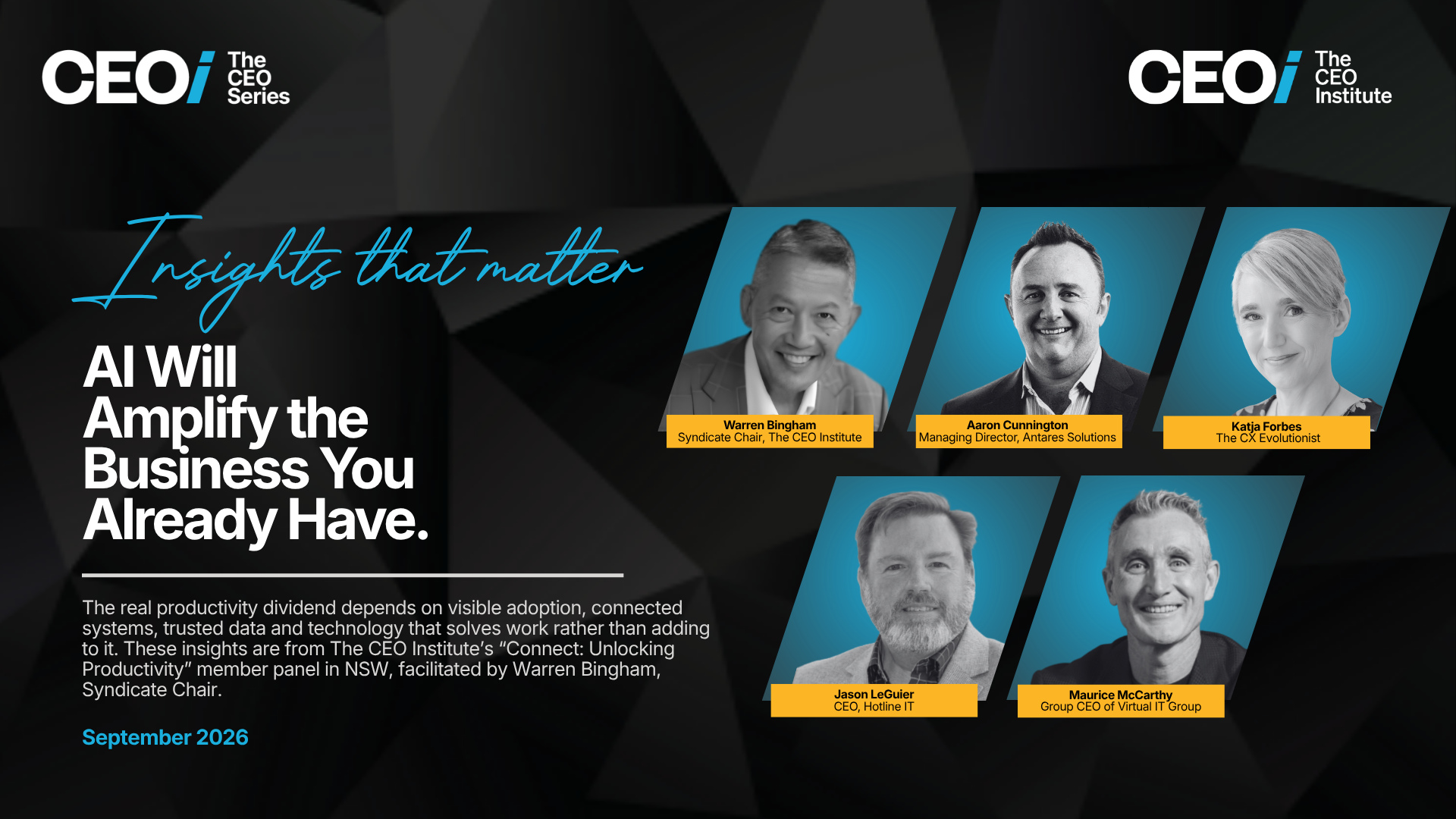
Insights from The CEO Institute Connect: Unlocking Productivity member panel, facilitated by Warren Bingham, Syndicate Chair, The CEO Institute.
Featuring fellow CEO Institute members Aaron Cunnington, Managing Director of Antares Solutions, Katja Forbes, The CX Evolutionist, Jason LeGuier, CEO of Hotline IT, and Maurice McCarthy, CEO of Virtual IT Group.
The systems, data and AI panel at The CEO Institute's New South Wales Connect: Unlocking Productivity event carried a technology title. Its real subject was leadership. Facilitated by Warren Bingham, the conversation moved past tools and into the conditions that determine whether AI creates value: culture, system architecture, adoption, customer experience, security and executive accountability. Aaron Cunnington brought data and implementation discipline, Katja Forbes the customer and experimentation lens, Jason LeGuier culture and risk, and Maurice McCarthy the realities of system sprawl and operational delivery.
Together, they exposed a truth every CEO and board should confront. AI will amplify the business it enters. In a coherent organisation, it can remove friction, accelerate decisions and create better service. In a fragmented one, it can spread unreliable information, deepen system complexity and automate poor work.
Your AI adoption has already started
Jason opened with a practical warning: employees will use AI whether the organisation has completed its strategy or not. The tools are inexpensive, accessible and already within reach. Leaders therefore face a cultural choice. They can encourage people to disclose, share and discuss how they are using AI, creating the visibility needed to govern it, or they can discourage experimentation and drive the same behaviour into personal accounts and unapproved tools.
This reframes governance. Waiting for a perfect policy does not preserve the status quo because the status quo is already changing. The immediate task is to make adoption visible, establish safe boundaries and learn from what people are trying to solve.
Aaron offered a valuable way to segment the workforce. Early adopters may already be paying for tools on personal credit cards. Bring them into the governed environment as champions. A second group understands the problem but needs approved tools and training. A third is busy doing today's job and sees little value in becoming an AI expert. Stop selling AI to them and provide a better way to complete a task that matters.
His own 60-person technology business learnt this during an early Microsoft Copilot rollout. Usage remained lower than expected because access alone did not change habits, confidence or priorities. A licence is not adoption, and an AI initiative is not change management.
System sprawl is now governance debt
Warren put a confronting statistic to the panel: some organisations operate more than 300 systems, while IT directly manages only around 15 per cent of them. Maurice explained how businesses arrive there. Teams want to be agile, move quickly and solve immediate problems, so functions acquire their own platforms. The result is shadow IT, weak integration, duplicated data and an expanding security burden.
Individual purchase decisions may have been reasonable, but the accumulated architecture traps data, obscures performance and passes its complexity into every AI use case. System coherence is now a productivity issue. Before acquiring another platform, executives should know what exists, who owns it, what data it holds, how it connects and whether it still earns its place. The goal is an intentional architecture in which systems, data and decision rights work together.
AI makes this work more urgent because fluent output can conceal weak foundations. If two systems define the same customer, cost or performance measure differently, AI will not settle the disagreement. It may simply provide a confident answer built on an unresolved one.
Move from proof of concept to proof of value
The panel repeatedly returned to solving real problems. Aaron described small solutions placed into production, where employees can see that the technology has improved their day. That success attracts attention, funding and further ideas. Demonstrations only prove that a model can perform a task, not that the organisation can change how work gets done.
Katja distinguished between three kinds of AI effort. Protect experimentation that builds learning and confidence. Tune AI that improves an existing process. Remove activity that produces no meaningful benefit. CEOs need enough literacy to tell the difference.
Her procurement and logistics examples showed AI negotiating capacity and supplier terms before the next stage of a transaction. This goes beyond drafting or summarising and changes the timing, economics and responsiveness of the process.
Maurice offered a practical service example. Virtual IT Group has used automation around service tickets and employee onboarding, turning work that moved across people and systems into an experience completed within minutes. HR moves faster, the employee has a better first experience and the customer receives a more capable service.
Productivity must reach the customer
Internal efficiency can look impressive while the burden shifts to an employee or customer. A faster process fails if people repeat information, navigate disconnected channels or cannot reach a human when judgement is required.
Jason drew a clear line between organisations using AI primarily to cut cost and those using it to transform how they serve. The stronger opportunity is to improve availability, responsiveness and value, perhaps enabling a business that traditionally operated within office hours to support customers around the clock. Maurice extended that logic by arguing that capacity released through automation should be reinvested in continuous improvement and better services, creating growth rather than a one-off saving.
The CEO Institute's view is clear: productivity is created when wasted work is removed and capacity is deliberately redirected. If AI is simply added to existing workloads, systems and priorities, it becomes another demand on the organisation rather than a source of performance.
Security begins with visibility and culture
An audience question about confidential data brought the governance challenge into sharp focus. The panel's response began with a practical principle: approved enterprise tools within a transparent culture are safer than employees using free personal accounts because the organisation has given them no workable alternative.
Security still requires rules for sensitive information, strong access controls, multifactor authentication, vendor scrutiny, monitoring and practical education. People must be able to disclose how they work, ask questions and report mistakes. Prohibition can create the appearance of control while increasing exposure.
The AI conversation can therefore strengthen the broader security conversation. It forces leadership teams to confront where data already sits, who can reach it, how systems connect and whether current controls reflect the value of the information being held.
The CEO must become an informed participant
Katja challenged senior leaders to become hands-on, noting that a simple agent can now be built in a matter of hours with the platform itself providing step-by-step guidance. The objective is not to turn CEOs into engineers. It is to give them enough experience to understand how the technology behaves, ask better questions and make more informed investment decisions.
The discussion rejected a linear transformation sequence. Strategy, culture, training, tools, use cases and governance must advance together. Warren's example of a global pharmaceutical company investing across manufacturing, drug discovery, finance and budget control showed the scale of the choice. Aaron showed how it can begin with a contained problem and credible proof of value.
Every CEO and board should now be asking five connected questions:
- Which valuable workflow, decision or customer outcome are we changing?
- Who is already using AI, with which tools and for what purpose?
- What systems and trusted data must connect for the use case to work?
- What risk does it create, and how will people escalate errors or edge cases?
- If it succeeds, what existing work, system or priority will stop?
When asked about the biggest mistake a CEO could make, Aaron's answer was to do nothing. The right response is disciplined movement: make AI part of the strategy, learn through real use, connect the foundations and keep leadership close to the work.
AI will amplify the business you already have. The leadership task is to make that business more coherent, more trusted and worth accelerating.