Skip to the main content.

4 min read

The hidden cost of certainty: how successful CEOs can stop their own businesses learning

The hidden cost of certainty: how successful CEOs can stop their own businesses learning


The hidden cost of certainty: how successful CEOs can stop their own businesses learning

How success, hierarchy and AI can narrow a leadership team’s thinking, and what CEOs can do about it.


Think about the strategic decision you are currently most confident about. What evidence would persuade you to reverse it? Who in your organisation would feel comfortable bringing you that evidence?

Those are different questions. A business can have the intelligence to recognise a mistake and still lack the conditions to correct it.

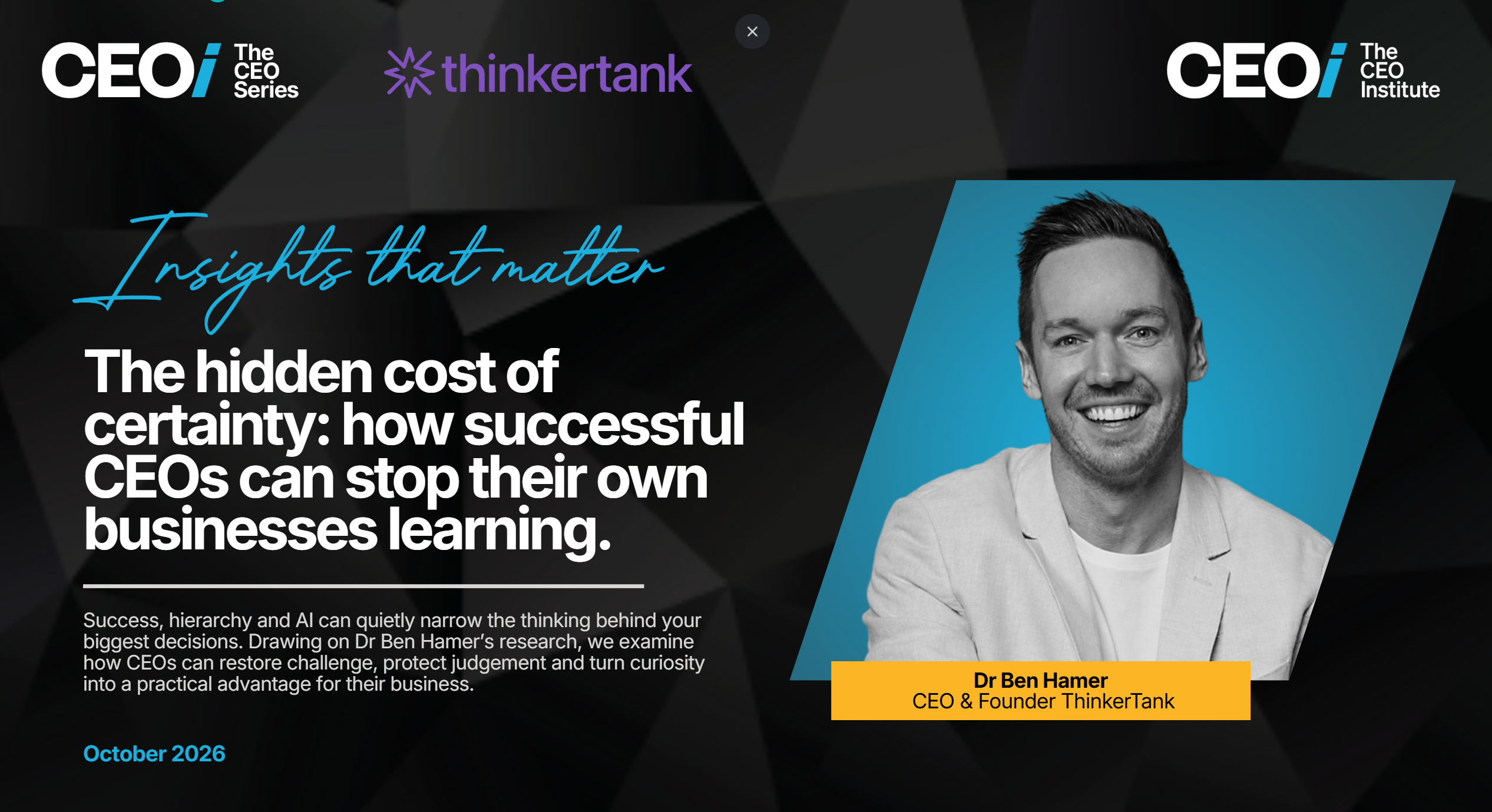
At a recent workshop, Dr Ben Hamer, founder and CEO of ThinkerTank, brought his report, Great Minds Don’t Think Alike, to life. His research into workplace curiosity raises an uncomfortable possibility for CEOs and business owners across Australia and New Zealand. The habits that helped us build successful businesses may also determine which warning signs we fail to see.


Experience can conceal the alternatives

Dr Ben discusses research involving expert chess players given problems with a familiar solution and a better, less obvious alternative. Players reported looking for another approach. Eye tracking showed their attention remained anchored to the solution they already knew.

They believed they were exploring.

For an experienced CEO, that is unsettling. We recognise patterns, move quickly and draw on judgements that have served us well. Yet those same strengths can direct our attention towards confirming a familiar explanation. We may investigate falling sales through the lens of sales execution while overlooking a change in what customers value. Experience remains essential. Its value depends partly on our ability to recognise when the context has changed. A useful test is to ask an independent person to build the strongest explanation that contradicts our own, using evidence we have not selected for them. The test becomes meaningful when their findings can alter the decision.


Silence can be a sensible career decision

The report cites US research in which 44% of workers said asking many questions made them look incompetent. It also draws on research reporting that curiosity declines by more than 20% within six months of starting a role.

Some questions naturally disappear as people learn their jobs. The leadership concern is which questions disappear, and why.

A new employee learns how the business operates. They also learn whose assumptions are safe to question. If a commercially useful challenge creates personal discomfort for an influential executive, staying quiet may become the sensible career decision. This makes curiosity a question of power. Consider a manager held accountable for delivery against a plan they privately believe is flawed. Can they reopen the underlying decision without being accused of resisting execution? An invitation to speak freely carries little weight if their performance review rewards agreement.

ThinkerTank’s Australian research adds another complication. Only 68% of women felt their organisation supported their curiosity, compared with 79% of men. An executive team can experience a culture as open while others encounter clear limits. We need to understand who can challenge whom, on which subjects, and with what consequences. Our own experience of being heard tells us little about the permission available to everyone else.


Different thinkers need influence

ThinkerTank identifies four expressions of curiosity: Explorers pursue unfamiliar possibilities, Detectives investigate inconsistencies, Connectors seek to understand people, and Challengers test accepted beliefs. The report recognises that everyone has all four, expressed differently.

The deeper issue for a leadership team is how those contributions interact with authority and resources. An Explorer’s growth proposal might attract funding while a Detective’s reservations are treated as delay. A Connector’s customer insight might be dismissed because it cannot yet be expressed in the preferred financial template.

The team can look diverse while its decisions consistently favour one way of thinking.

Before the next major investment, trace which perspectives changed the proposal. Whose evidence influenced the budget? Which objection led to a test? Who was heard politely and then ignored? That examination tells you more about the use of different perspectives than the personalities around the table.


AI can make a weak decision harder to detect

Dr Ben’s report describes experiments in which 73% of participants accepted a confidently incorrect AI answer. Their confidence increased despite the error. The executive implication deserves attention: better presentation can make an inadequately tested proposition easier to approve.

Imagine a market-entry strategy, financial narrative and board paper produced with AI from the same initial assumptions. Their consistency may look like corroboration. All three could be repeating the same mistake.

There is a longer-term capability question too. If emerging managers increasingly receive completed analysis, where will they develop the judgement needed to challenge it? A business may accelerate today’s output while giving tomorrow’s leaders fewer opportunities to practise thinking through uncertainty.

Research cited in the report found benefits when people attempted a problem before consulting AI, provided sufficient time was available. For consequential decisions, that suggests a practical discipline. Have people record their initial reasoning, uncertainties and evidence needs before using AI to develop alternatives. Then investigate disagreements. Accountability becomes more credible when the process preserves the thinking required to exercise it.


Curiosity needs commercial discipline

ThinkerTank models the annual cost of suppressed curiosity at approximately 4% of payroll, through assumptions about rework and turnover. That figure is a hypothesis to test within your business. Rework also arises from weak processes, missing skills and confused responsibilities.

There is a further distinction between recovering time and realising value. Eliminating ten hours of duplicated work releases capacity. The commercial return depends on what happens to those hours next. They could support customers, reduce overtime or disappear into more internal activity.

And a business can deliver an outdated proposition flawlessly. No rework appears in the numbers, yet its relevance declines. Curiosity’s strategic value includes recognising when the work itself needs to change. Changing direction early can be worth far more than a marginal productivity gain.

Start with one recurring, expensive problem. Identify which assumption went untested, who could have challenged it and what prevented them. Give a team a defined period to investigate, make a decision and track the consequences. Agree what evidence would justify reopening the decision, so inquiry supports timely execution.

Then examine your own response when the findings arrive. If the evidence undermines a strategy you sponsored, changing direction can feel personally costly, particularly when the board has backed your judgement. Continuing may carry a larger cost to the business.

Your response will determine what people bring you next.

To explore these ideas further, download Dr Ben Hamer and ThinkerTank’s Great Minds Don’t Think Alike. Its research, curiosity framework and leadership discussion guide provide a starting point for examining where your organisation’s thinking is being constrained, and what you could gain by giving it room to change.


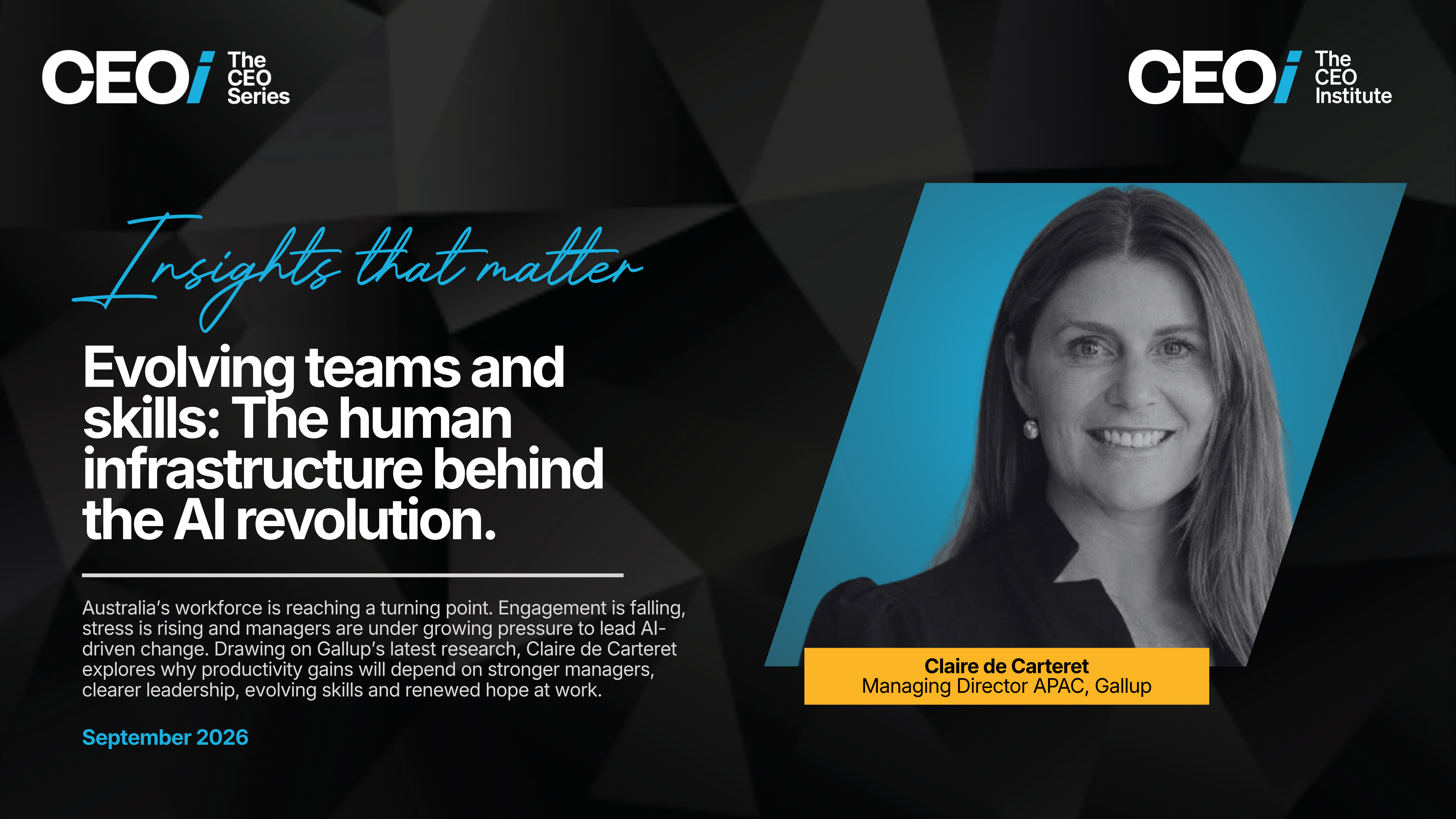
Why Organisational Confidence Begins with the CEO

Why Organisational Confidence Begins with the CEO

Australia is not short of demand. It is short of the productive capacity needed to meet that demand without creating higher prices.
Read More
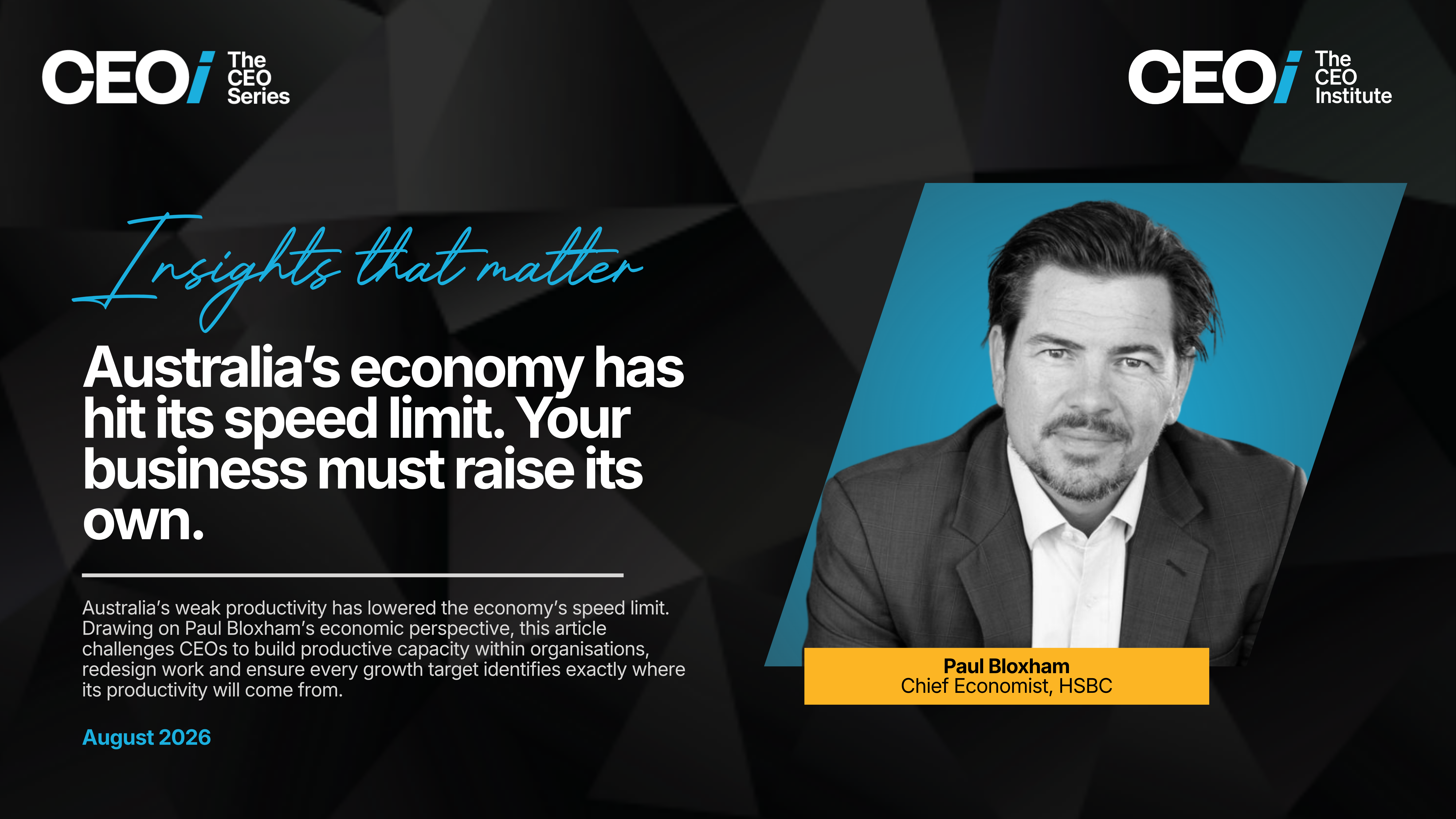
Evolving teams and skills: The human infrastructure behind the AI revolution

Evolving teams and skills: The human infrastructure behind the AI revolution

Australia is not short of demand. It is short of the productive capacity needed to meet that demand without creating higher prices.
Read More
Australia’s economy has hit its speed limit. Your business must raise its own.

Australia’s economy has hit its speed limit. Your business must raise its own.

Australia is not short of demand. It is short of the productive capacity needed to meet that demand without creating higher prices.

Read More