The hidden cost of certainty: how successful CEOs can stop their own businesses learning
Australia is not short of demand. It is short of the productive capacity needed to meet that demand without creating higher prices.
5 min read
The CEO Institute Published
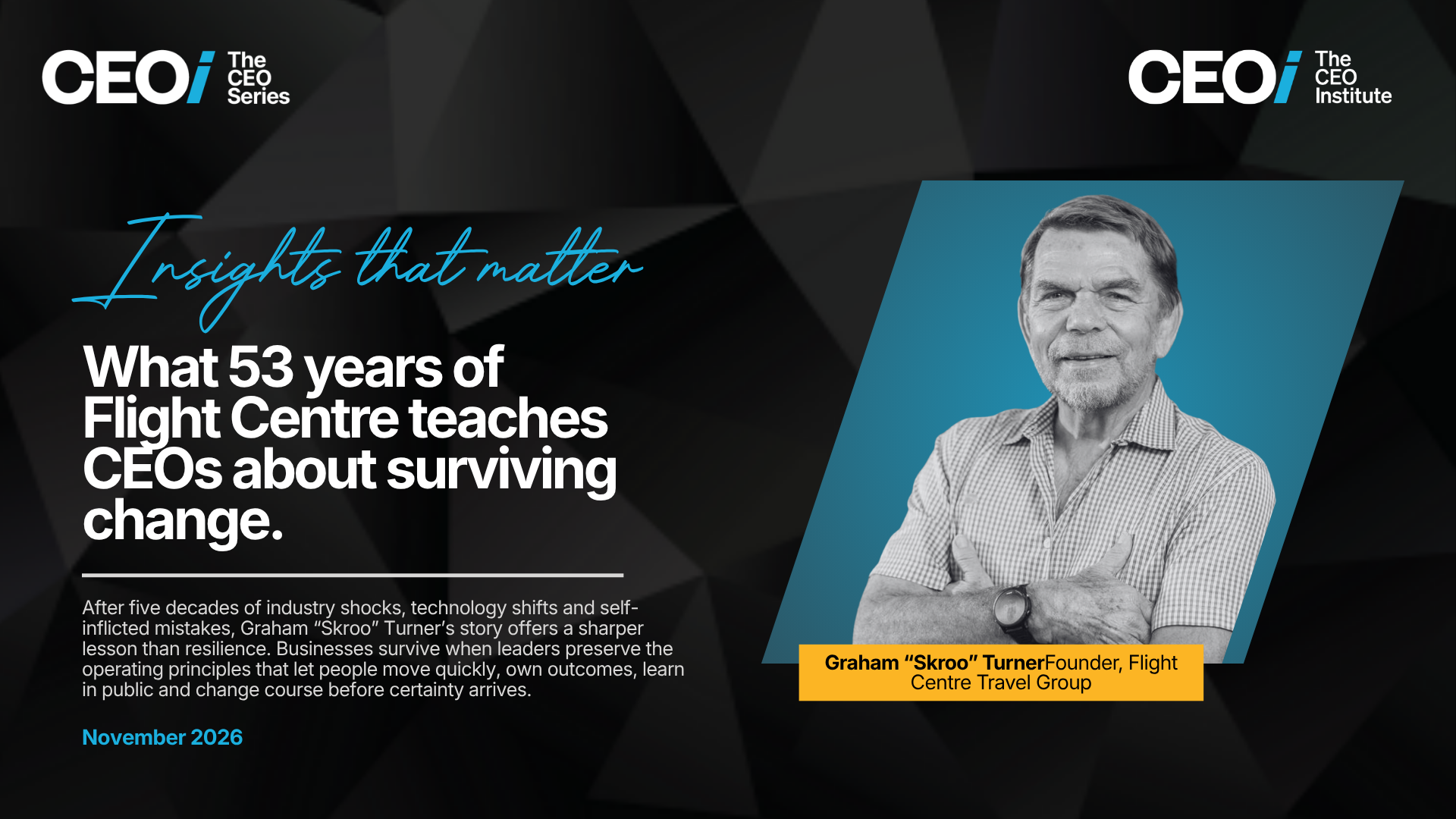
The Discipline Behind the Rebel: What 53 Years of Flight Centre Teaches CEOs About Surviving Change
After five decades of industry shocks, technology shifts and self-inflicted mistakes, Graham “Skroo” Turner’s story offers a sharper lesson than resilience. Businesses survive when leaders preserve the operating principles that let people move quickly, own outcomes, learn in public and change course before certainty arrives.
At our most recent Lunch Series event in Brisbane, held in partnership with Pitcher Partners QLD, Kieran Wallis opened with an interesting and useful contradiction. Business confidence is under pressure and costs remain stubborn. At the same time, Queensland is entering an extraordinary infrastructure cycle, AI is putting powerful productivity tools into every organisation, and Brisbane 2032 is creating a global platform well before the opening ceremony. Queensland’s current four-year transport programme alone represents $55.9 billion of investment.
Then Ray Weekes AM, one of our QLD Syndicate Chairs, sat down with Graham “Skroo” Turner for a fireside conversation in front of our QLD community.
Graham has spent more than five decades leading through contradictions: growth and crisis, rebellion and discipline, fun and accountability. He has been spectacularly right, publicly wrong and willing to stay in the game long enough to learn the difference.
The farm came before the empire
Long before Flight Centre, there was an apple orchard near Stanthorpe. Graham worked in the family business from childhood and grew up in a one-teacher school where self-reliance was simply how life worked. By his own account, he understood early that business had income, costs and one basic requirement: the first had to exceed the second.
He later trained as a veterinarian, moved to London and, in 1973, invested with Geoff “Spy” Lomas in an ageing double-decker bus. What began as a way to travel became Top Deck. Flight Centre followed in Australia. Today, the group Graham helped build recorded $25.7 billion in total transaction value in FY26.
The temptation is to call this entrepreneurial instinct. I think it is more specific.
Graham has spent his life getting close enough to the problem that action becomes possible. He rarely began with perfect information. He began with proximity, judgement and a willingness to move.
Large organisations often create the opposite condition. Information travels upwards, decisions travel downwards, and the people closest to the customer wait for permission from people furthest from the problem.
Rebellion only works when discipline sits underneath it
Flight Centre’s three core values remain egalitarianism, ownership and irreverence. The company still organises itself around “families, villages and tribes”, small operating units intended to keep a large business accountable and human.
There is hard commercial logic behind it. Small teams make performance visible. Ownership makes consequences personal. Egalitarianism reduces distance between leaders and the front line. Irreverence gives people permission to challenge convention.
This is where Graham’s belief in “fun” is often misunderstood.
During the conversation, he refined it. Fun does not mean constant parties. It means creating a workplace people genuinely like being part of, where effort is recognised, relationships matter and success is celebrated. His test was simple: is this a workplace you would be happy for your children to work in?
That is a more demanding culture question than an engagement score.
The most valuable story was the failure
Graham’s strongest lesson may come from one of Flight Centre’s worst episodes.
In 2004, the company launched a transformation programme called “Full Throttle”. Revenue had grown strongly, profits had stalled and head office costs had expanded. External consultants promised more than $100 million in savings over three years.
The logic looked compelling. The execution was disastrous.
The restructure cut across Flight Centre’s culture. Senior outsiders were elevated into key roles and long-serving people were displaced through processes they saw as fundamentally at odds with the organisation they had built. Morale collapsed, key people left and profits fell 17% in 2004/05.
The failure was not the use of advisers. Specialist expertise can be valuable. The failure was allowing external expertise to replace internal judgement.
Graham concluded that Flight Centre had gone looking for “silver bullets” that did not exist. The company reversed course, restored experienced insiders to leadership and embedded a stronger preference for promotion from within.
There is an uncomfortable question here for every CEO pursuing transformation: are you using outsiders to strengthen your organisation’s judgement, or because you have stopped trusting your own people to solve the problem?
No transformation survives if the method destroys the cultural assets required to deliver it.
Then came a crisis no model could absorb
COVID took that principle to an extreme.
Flight Centre entered the pandemic with monthly operating costs of about $227 million and roughly 21,000 people. As travel collapsed, the leadership team drove monthly costs towards $65 million. Thousands lost their jobs, stores closed and capital was raised.
There is nothing romantic about that. It exposes what resilience actually means.
Resilience is not optimism after the event. It is the organisational capacity to make ugly decisions while there is still something left to save.
The business that emerged was structurally different. Flight Centre’s FY26 results show record transaction value, stronger productivity in corporate travel and a growing technology layer across the group.
Survival was not a return to the old Flight Centre. It forced the next version into existence.
AI is Graham’s second internet moment
There was humour in Graham admitting that, years ago, he dismissed the internet as something of a passing phase.
That admission made his comments on AI more valuable.
He does not pretend to know exactly where AI ends. He sees major productivity gains, genuine disruption risk and a capability curve moving faster than most organisations can absorb. Flight Centre is already deploying AI across search, analytics, customer support and consultant tools, including an AI acceleration unit and agentic capabilities across parts of the customer journey.
His framing of the human role was particularly useful.
AI can increasingly handle the predictable journey. The harder question is what happens when the plane is cancelled, the itinerary collapses, the customer is stranded and somebody has to own the outcome.
That is where human value may become more concentrated.
For CEOs, the better question is not “Where can AI replace people?”
It is: where do variability, consequence or emotion make human judgement more valuable, and how do we use AI to remove everything around that moment that does not require it?
Accountability is still the hard part
Towards the end of the discussion, Graham returned repeatedly to outcomes.
“What gets rewarded gets done” has long sat inside Flight Centre’s operating philosophy. His view is that leaders should be able to define the outcome expected from a role or team. If you cannot explain what value a function creates, you should at least be prepared to ask why it exists. Flight Centre’s remuneration architecture still explicitly links incentives, ownership and measurable outcomes.
Too many organisations confuse activity with contribution. Meetings are completed. Reports are produced. Teams stay busy. Headcount becomes a proxy for importance.
Graham’s challenge is simpler:
What changed because this team exists?
Not every contribution fits neatly into a sales number. Legal, risk, culture and leadership all contain qualitative value. But qualitative does not mean unaccountable.
As technology absorbs more activity, businesses will have less tolerance for work whose outcome cannot be explained.
Perhaps survival is the legacy
When Ray asked Graham about his greatest achievement, the answer was not a share price, an acquisition or a global footprint.
It was survival.
More than 50 years after an old bus and a questionable plan to drive people around Europe, Graham is still leading a business that has survived deregulation, the internet, terrorism, SARS, the GFC, its own mistakes, a pandemic and now another technological reset.
That does not happen because a founder is always right.
It happens because the organisation learns how to be wrong without staying wrong.
That is the point I took away. The strongest businesses are built to absorb reality quickly, confront mistakes, preserve what is distinctive, discard what no longer works and keep moving.
The rebel instinct gets the attention.
The discipline underneath it is what keeps you alive.
Australia is not short of demand. It is short of the productive capacity needed to meet that demand without creating higher prices.