Skip to the main content.

5 min read

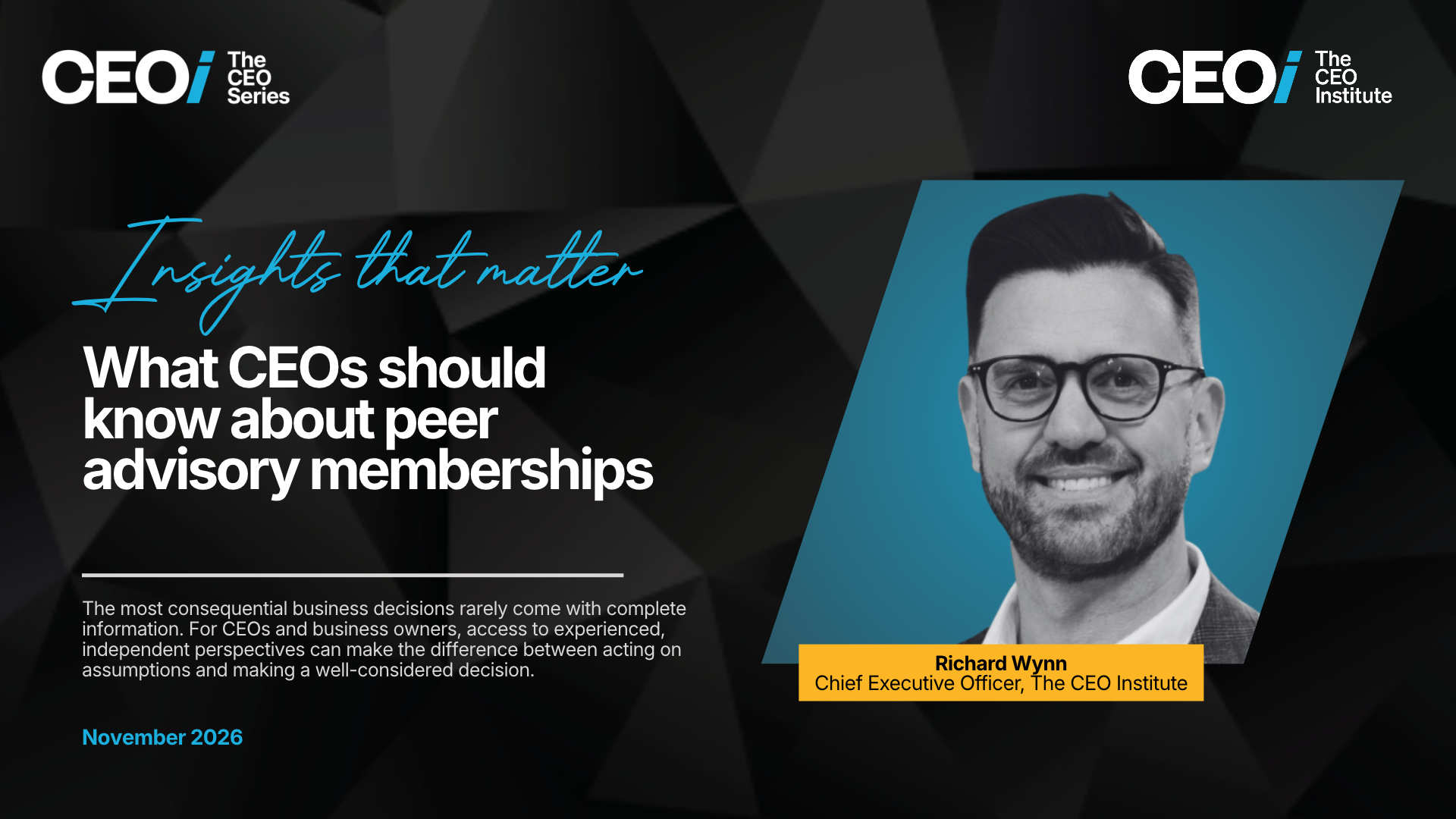
What CEOs should know about peer advisory memberships

What CEOs should know about peer advisory memberships


What CEOs should know about peer advisory memberships

The most consequential business decisions rarely come with complete information. For CEOs and business owners, access to experienced, independent perspectives can make the difference between acting on assumptions and making a well-considered decision.

Every CEO makes decisions that carry significant consequences. Whether navigating an acquisition, restructuring a leadership team, entering a new market or responding to financial pressure, the responsibility ultimately sits with the person at the top.

Most leaders have access to advice. They have executive teams, boards, professional advisers and industry contacts. Yet finding someone who can challenge their thinking without a direct stake in the outcome can be surprisingly difficult.

Internal teams bring valuable expertise, but their perspectives are shaped by the organisation's priorities, relationships and operating environment. Boards provide oversight, while external advisers often contribute specialist knowledge. Each plays an important role, but there remains a place for advice from people who understand the responsibility of leading an organisation because they carry that responsibility themselves.

This is where CEO peer advisory groups offer a valuable advantage. They bring experienced business leaders together in a confidential environment where they can examine challenges, question assumptions and draw on one another's experience before committing to a course of action.


Better decisions begin with better questions

Experience is one of a CEO's greatest assets. Years of navigating uncertainty, managing people and making commercial decisions develop judgement that cannot be acquired through theory alone.

However, experience can also create blind spots.

Leaders naturally draw on what has worked previously. They develop preferred approaches, established beliefs and familiar ways of interpreting information. These instincts are valuable, but they can become limiting when circumstances change or a challenge requires a different perspective.

Consider a CEO planning to enter a new market. The financial projections are encouraging, the executive team supports the opportunity and early customer feedback suggests strong demand.

The decision appears sound.

But what assumptions are being made about the organisation's ability to execute? Has the leadership team considered how expansion might affect its existing customers? Is the proposed timing driven by genuine opportunity or pressure to maintain growth?

These are questions that might emerge in a trusted peer advisory environment.

The value comes from having experienced leaders examine the decision from different angles, drawing on their own commercial successes, mistakes and lessons learned.

A well-placed question can expose a risk that has been overlooked, reveal an alternative approach or provide greater confidence that the original strategy is sound.


The importance of perspectives outside your organisation

One of the challenges of executive decision-making is that the people closest to the business often share similar information, assumptions and organisational pressures.

Even strong executive teams can develop a common view of a problem. Over time, established processes and internal relationships influence which options are considered and which questions are asked.

Independent perspectives help interrupt this pattern.

Within CEO peer advisory groups, members typically come from different industries and non-competing organisations. They bring experience shaped by different markets, operating models, customer expectations and commercial challenges.

A manufacturing CEO might offer valuable insight into operational efficiency. A technology founder may see opportunities to redesign processes. A professional services leader could contribute a different perspective on talent, succession or client relationships.

While their businesses differ, the underlying leadership challenges often have much in common.

This diversity gives CEOs access to thinking that may be unavailable within their own organisations or established business advisory networks.

Importantly, the exchange works both ways. Members contribute their own experience while benefiting from the perspectives of others. Over time, this creates a trusted environment where commercial knowledge is shared openly and constructively.


A confidential environment for complex business decisions

Some leadership challenges are difficult to discuss openly.

A CEO may have concerns about an executive's performance, doubts about the direction of the business or uncertainty about a major investment. There may be sensitive succession questions, shareholder tensions or concerns about their own capacity to lead through sustained pressure.

These issues require careful consideration, but sharing them internally can create unintended consequences.

A confidential peer advisory membership provides an opportunity to explore these challenges with people outside the organisation who understand the stakes.

For example, a business owner considering a significant restructure may want to examine the commercial rationale alongside the potential impact on employees, customers and organisational culture.

Other members may have navigated similar decisions. They can share what worked, what they underestimated and what they would approach differently.

The CEO remains responsible for the decision. However, they can return to the business having considered a broader range of consequences and options.

Confidentiality is fundamental to this process. Without trust, conversations remain superficial and members are less likely to raise the issues that matter most.

The strongest peer advisory environments develop relationships that allow leaders to speak openly, disagree respectfully and provide candid feedback.


Why the quality of the room matters

The effectiveness of a peer advisory group depends heavily on the people participating.

A group of experienced CEOs brings considerable knowledge into the room, but experience alone does not guarantee valuable discussion.

Members need to be willing to contribute, listen carefully and challenge one another's thinking. They must be comfortable acknowledging uncertainty and sharing experiences that did not produce the intended outcome.

The role of an experienced Chair is equally important.

A skilled Chair helps members examine the underlying issue rather than simply responding to the presenting problem. They guide conversations, encourage different perspectives and ensure discussions lead towards practical insights.

The best Chairs recognise when a CEO needs to be challenged, when additional context is required and when the group should explore the broader implications of a decision.

This combination of carefully matched peers, experienced facilitation and mutual accountability distinguishes a structured peer advisory membership from conventional networking.

Members are building relationships with people they trust to tell them what they need to hear, even when that perspective challenges their initial thinking.


The value extends beyond individual decisions

While many CEOs join peer advisory groups seeking practical CEO leadership support, the benefits can extend well beyond the immediate challenges facing their business.

Regular engagement with experienced peers creates opportunities to develop stronger judgement over time.

A CEO might gain perspective on managing a difficult board relationship during one meeting, explore emerging technology opportunities at another and reconsider their approach to leadership succession several months later.

These conversations contribute to a broader understanding of how other organisations operate and how different leaders respond to uncertainty.

They also create space for reflection.

For CEOs managing constant operational demands, it can be difficult to step outside the immediate pressures of the business and consider the bigger picture.

A regular peer advisory meeting provides a structured opportunity to do exactly that. It encourages leaders to examine strategic priorities, identify emerging risks and consider whether their current approach remains appropriate.

The cumulative value is significant: better questions, more considered decisions, stronger relationships and a broader perspective on leadership.


Choosing the right CEO peer advisory group

For CEOs considering membership, several factors deserve attention.

The experience and composition of the group should be a priority. Members should bring credible leadership experience, diverse commercial perspectives and a genuine willingness to contribute.

Confidentiality must be clearly established with a formal written agreement, while the Chair should have the experience and facilitation skills to guide meaningful conversations.

The format also matters. Regular meetings, consistent participation and a structured approach help members build trust and explore challenges in greater depth.

Above all, the environment should encourage constructive challenge rather than simply reinforce existing opinions.

At The CEO Institute, this philosophy underpins The CEO Syndicate. Carefully matched groups of non-competing CEOs, Managing Directors, founders and business owners meet regularly under the guidance of experienced Chairs.

Members bring real business challenges into a confidential setting, drawing on the collective experience of leaders who understand the responsibility of making decisions at the highest level.


Stronger leadership through shared experience

The responsibility for leading a business ultimately rests with the CEO, but effective leadership does not require every challenge to be worked through independently.

Access to trusted peers creates opportunities to test assumptions, examine risks and learn from the experience of others before making consequential decisions.

Sometimes that process confirms the path forward. Sometimes it reveals an entirely different option.

In either case, the CEO benefits from a broader perspective and a more considered approach to the decision.

For business leaders navigating increasing complexity, having access to people who understand the challenges of leadership is a valuable resource.

Because the quality of a decision is often shaped by the quality of the conversations that happen before it.

Discover how The CEO Syndicate connects CEOs and business owners with experienced peers in a confidential advisory environment.


Australia’s economy has hit its speed limit. Your business must raise its own.

Australia’s economy has hit its speed limit. Your business must raise its own.

Australia is not short of demand. It is short of the productive capacity needed to meet that demand without creating higher prices.
Read More
Why Organisational Confidence Begins with the CEO

Why Organisational Confidence Begins with the CEO

Australia is not short of demand. It is short of the productive capacity needed to meet that demand without creating higher prices.

Read More
“Work” is the only major corporate investment most boards do not govern

“Work” is the only major corporate investment most boards do not govern

Australia is not short of demand. It is short of the productive capacity needed to meet that demand without creating higher prices.

Read More