Skip to the main content.

5 min read

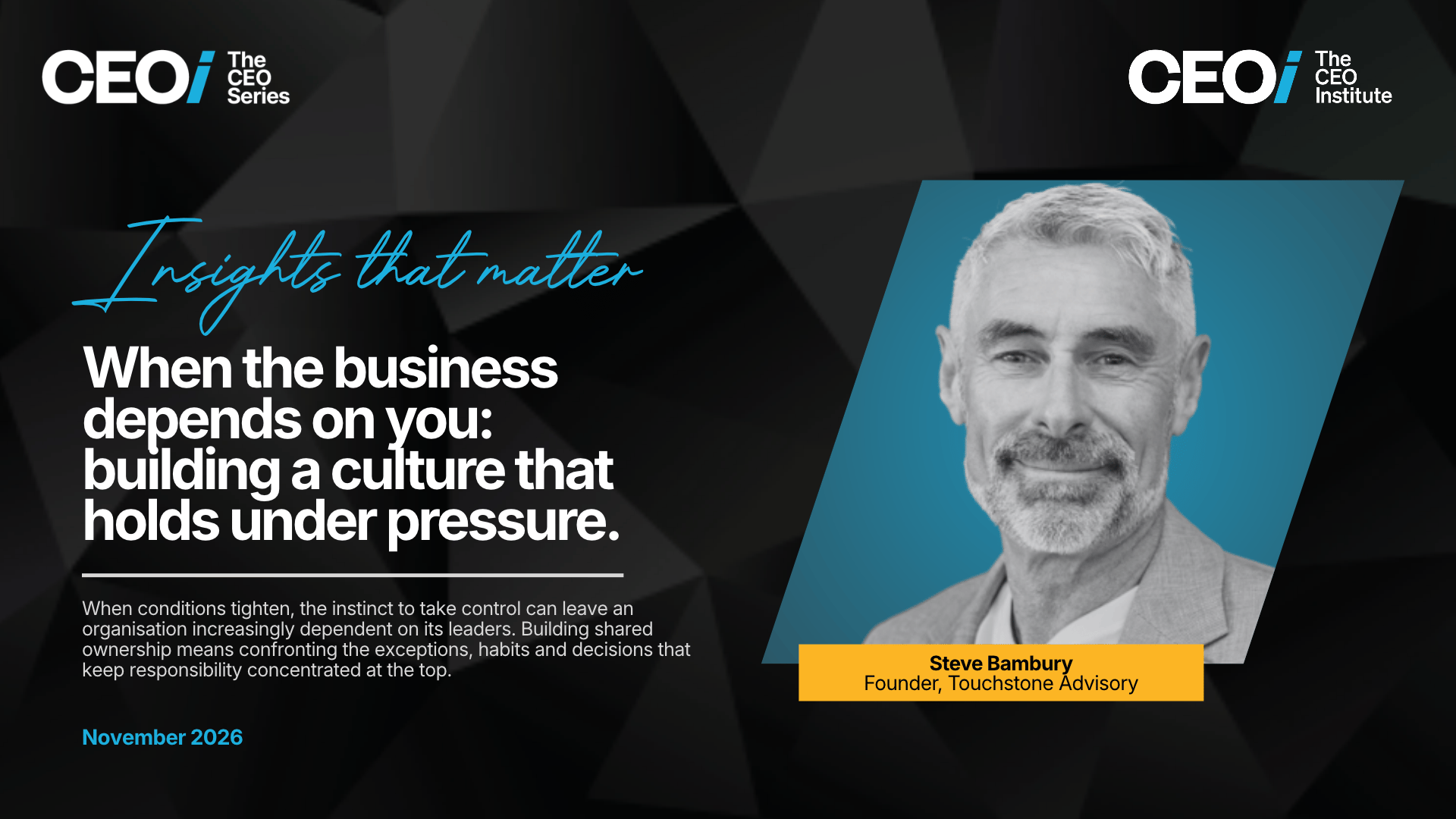
When the business depends on you: building a culture that holds under pressure

When the business depends on you: building a culture that holds under pressure


When the business depends on you: building a culture that holds under pressure

When conditions tighten, the instinct to take control can leave an organisation increasingly dependent on its leaders. Building shared ownership means confronting the exceptions, habits and decisions that keep responsibility concentrated at the top.

By Richard Wynn, Chief Executive Officer, The CEO Institute, in collaboration with Steve Bambury, Founder, Touchstone Advisory.


It's Friday afternoon. Two teams need a decision, and the one person who usually makes it is on a plane. Nothing moves until Monday.

Our recent Productivity Special Pulse Report found that 40.4% of ANZ respondents described execution as dependent on individual leaders or teams. For CEOs, boards and owners, this raises a question about the quality of performance: how much can the organisation sustain without particular people continually holding it together?

Steve Bambury, Founder of Touchstone Advisory, led the culture development work at Ray White Austar in New Zealand from 2019 and has since been invited back to lead its next refresh. Working directly with the owners and sales team, he helped a business with good results and an already solid culture build greater shared ownership of its standards. The behaviour of those two agents exposed a tension familiar to many CEOs: standards become negotiable when the business feels dependent on someone’s contribution..

Steve’s experience at Austar, alongside insights from his emerging research, provides the foundation for this article’s central question: how do leaders build a business that performs without everything depending on them?

That dependence reaches beyond difficult high performers. It appears whenever decisions wait for a founder, competing teams need an executive to resolve priorities, or a conscientious manager repeatedly steps in to rescue delivery. Each intervention can keep today’s work moving while leaving tomorrow’s work equally dependent on the same person.


Case Study: What the business really permits

Two salespeople were bringing in strong listings and earning good money. Their behaviour towards colleagues was also falling short of the respect expected across the business. For Ray White Austar, the commercial challenge was deciding how much revenue those standards were worth.

So, throughout Austar, the team helped define and vote on five values: respect, integrity, empathy, commitment to a common outcome and courageous honesty. Branch culture ambassadors helped maintain those standards, which also informed recruitment and client conversations. As General Manager and co-owner Len Day put it: “It wasn’t my culture. It wasn’t the owner’s culture. It was our culture.”

The test came when those standards carried a cost. The two agents eventually left, creating a short-term loss of listings and income. They left because it was too uncomfortable for them to stay. Accepting that loss gave everyone else evidence that the agreed standards applied when money was involved.

A CEO who makes exceptions for a valuable producer teaches colleagues how to interpret every subsequent statement about respect. Employees learn which behaviours the organisation rewards, and whose contribution buys immunity. Shared ownership becomes difficult when people suspect that challenging the wrong person will leave them exposed.

The board implication is equally uncomfortable. Revenue concentration can distort judgement about conduct. Examining how the organisation would cope with losing a dominant contributor can reveal both a commercial vulnerability and a reason unacceptable behaviour has survived.


Values that help people decide

One Austar manager met a seller who had received unrealistic price expectations from other agents. He explained what he believed the property could achieve, accepting that honesty might cost him the listing. The seller called back the following day and appointed him.

The useful lesson concerns how the decision was made. Courageous honesty gave the manager a basis for choosing between winning an instruction and protecting credibility. He could exercise judgement without asking an owner to settle the trade-off. That is a practical contribution culture can make to execution.

Values become useful when employees understand the choices they authorise and the costs leaders will accept. “Integrity” leaves considerable room for interpretation. Agreeing how to respond when a customer requests an unrealistic promise gives people something they can use under pressure. Leaders can then coach against a shared standard rather than substitute their judgement each time.

Austar also invested in mentoring, lead generation and its own platform, HQ, bringing tools together to support agents’ work. Len reports growing market share and improvements in recruitment and retention, although the figures remain confidential. These are reported outcomes of several changes working together. Culture alone cannot take credit for them.

Ray White Austar is a business that chose to invest in its people when it didn't have to. Its leaders saw culture as a competitive advantage and have kept investing in it through one of the toughest markets in years. Today, experienced agents from other brands are choosing to join them."


The dependency created by helping

Steve’s emerging research interviews expose a less obvious source of dependence: generosity. One owner responded to stretched managers by drafting their client emails and taking work off their hands. The intention was supportive. The consequence was that decisions and responsibility remained with him.

The Pulse Report identifies management stretch as the leading people-related constraint, selected by 26.8% of Australian respondents and 39.1% in New Zealand. Repeatedly rescuing delivery can consume the time needed to coach people towards greater independence. The team receives immediate relief while the manager’s capacity to improve the situation keeps shrinking.

Leaders need to distinguish a temporary capacity shortage from uncertainty about authority or a gap in capability. Those problems require different responses. Extra resources may address workload. Clear decision boundaries address authority. Coaching and supervised practice develop judgement. Taking the task back can conceal all three, making the organisation appear more capable than its operating arrangements actually allow.

Austar’s current refresh reflects a related challenge. Its leaders want greater stretch alongside the care already present. Personal commitments, accountability partners and conversations about values in action are intended to make expectations more visible. Care needs to help people meet demanding standards, including through honest feedback when performance falls short.

In a trade business with 60 employees, Steve found a different approach to sharing authority. New recruits spend three months rotating through crews, and the crews decide whether they stay. The people who work alongside a recruit have a direct role in judging their suitability. That makes ownership tangible, while requiring leaders to ensure that selection reflects agreed standards. Delegation needs those safeguards, especially where personal preferences could otherwise determine who belongs and whose contribution is recognised within the wider team.


Ownership extends beyond the payroll

Some of Steve’s strongest examples come from construction. A residential builder with six full-time employees involves subcontractors in decisions, pays them within a week and builds clearly defined roles and systems. He reports that around 80% of his core subcontractors have worked with him for more than five years.

These early interviews do not establish that trust causes retention. They do illustrate how leadership choices affect the experience of working with a business. Prompt payment and respect for expertise give contractors practical reasons to prioritise a relationship. Shared scheduling can prevent a trade arriving at a site that is unready, wasting travel and disrupting subsequent jobs.

For a larger enterprise, the equivalent dependency may sit between procurement, operations and a critical supplier. Someone repeatedly phones around to repair handovers, and their effort hides the weakness. Making that coordination reliable releases capacity across the relationship. A culture of ownership has to reach the people whose cooperation delivery requires, including those employed elsewhere.


Make one decision less dependent

Steve proposes a starting exercise: if you were unreachable for two weeks, which five decisions would stall? Choose one and examine why. Identify the outcome, the information required, who has the capability to decide and the circumstances that require escalation.

Agree the limits, provide support and review the results. Resist taking authority back at the first uncomfortable moment. In an SME, that may mean an owner allowing a manager to handle a customer issue. In an enterprise, it may mean giving two functions a shared rule for resolving competing priorities.

Boards can track progress through repeated escalations, decisions delayed by absence and the time executives spend rescuing routine work. Strong results can coexist with fragile execution. Leadership earns its lasting value through the judgement and capacity people can exercise when the leader is unavailable.


To read Steve Bambury’s research about building cultures of high performance for the building and construction sector click here:  https://touchstoneadvisory.com.au/construction-white-paper/


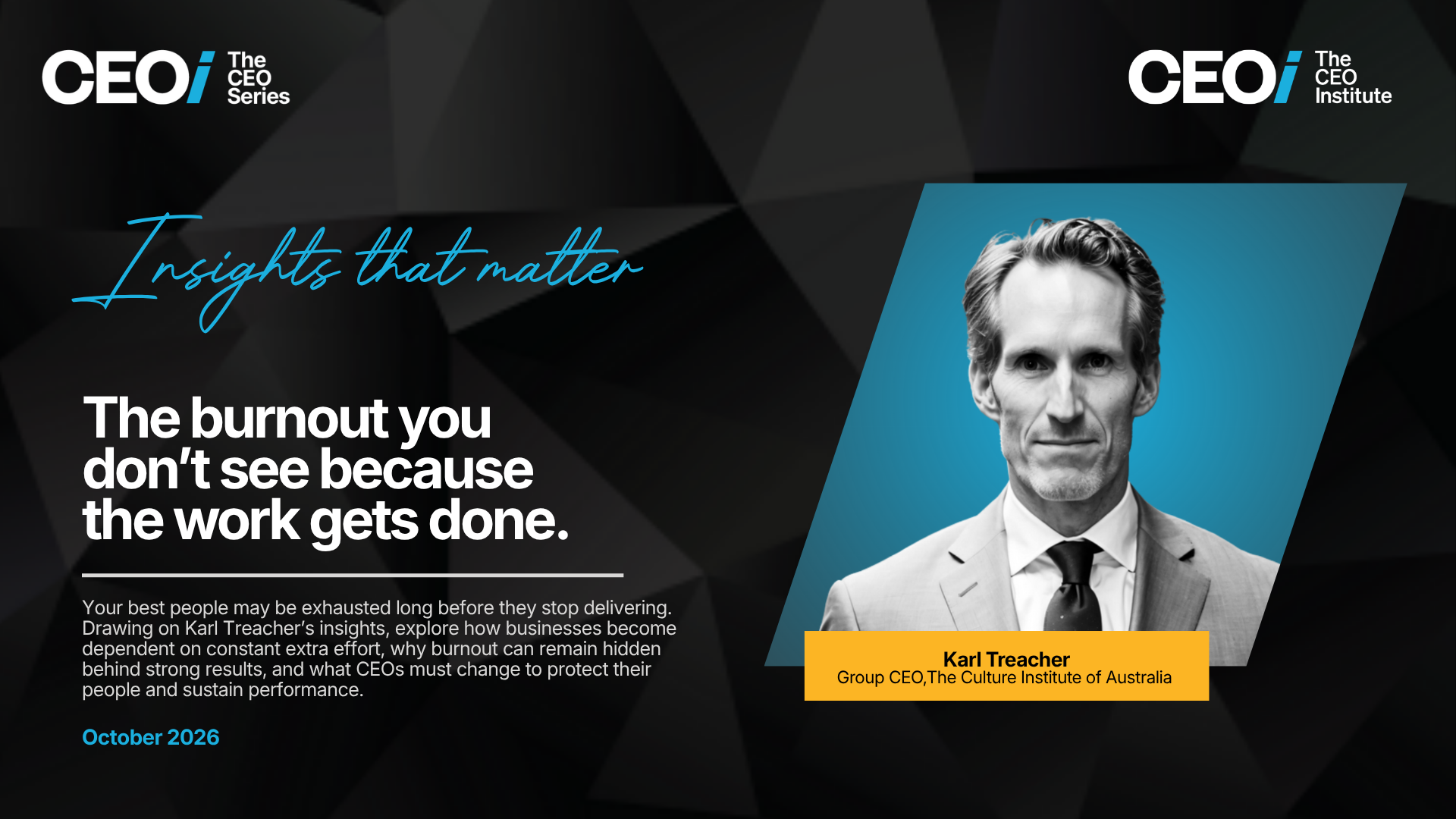
The burnout you don't see because the work gets done

The burnout you don't see because the work gets done

Australia is not short of demand. It is short of the productive capacity needed to meet that demand without creating higher prices.
Read More
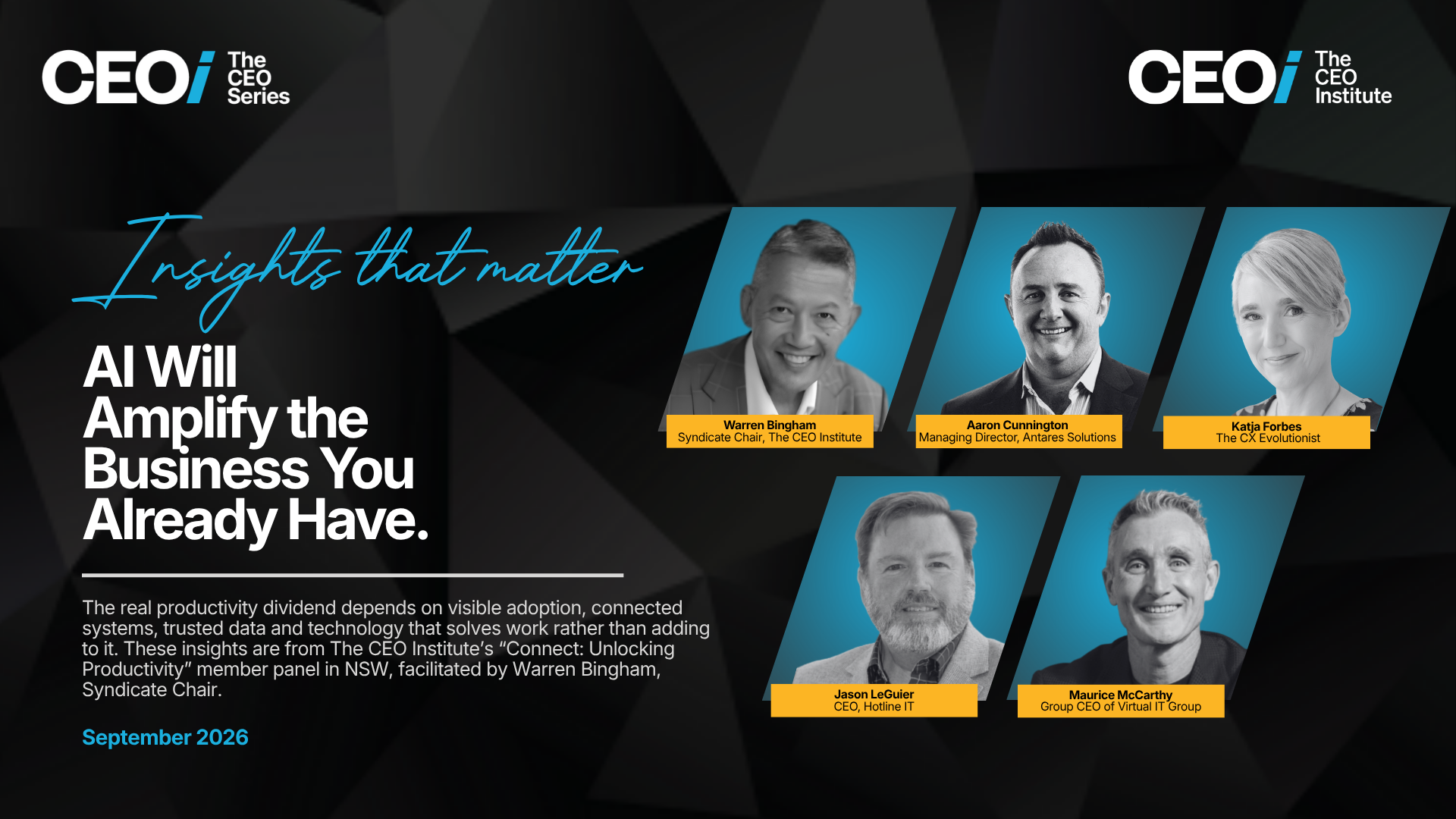
AI Will Amplify the Business You Already Have

AI Will Amplify the Business You Already Have

Australia is not short of demand. It is short of the productive capacity needed to meet that demand without creating higher prices.

Read More
The hidden cost of certainty: how successful CEOs can stop their own businesses learning

The hidden cost of certainty: how successful CEOs can stop their own businesses learning

Australia is not short of demand. It is short of the productive capacity needed to meet that demand without creating higher prices.

Read More